
Fifteen years of experience improving operations. A career spent making processes more efficient.
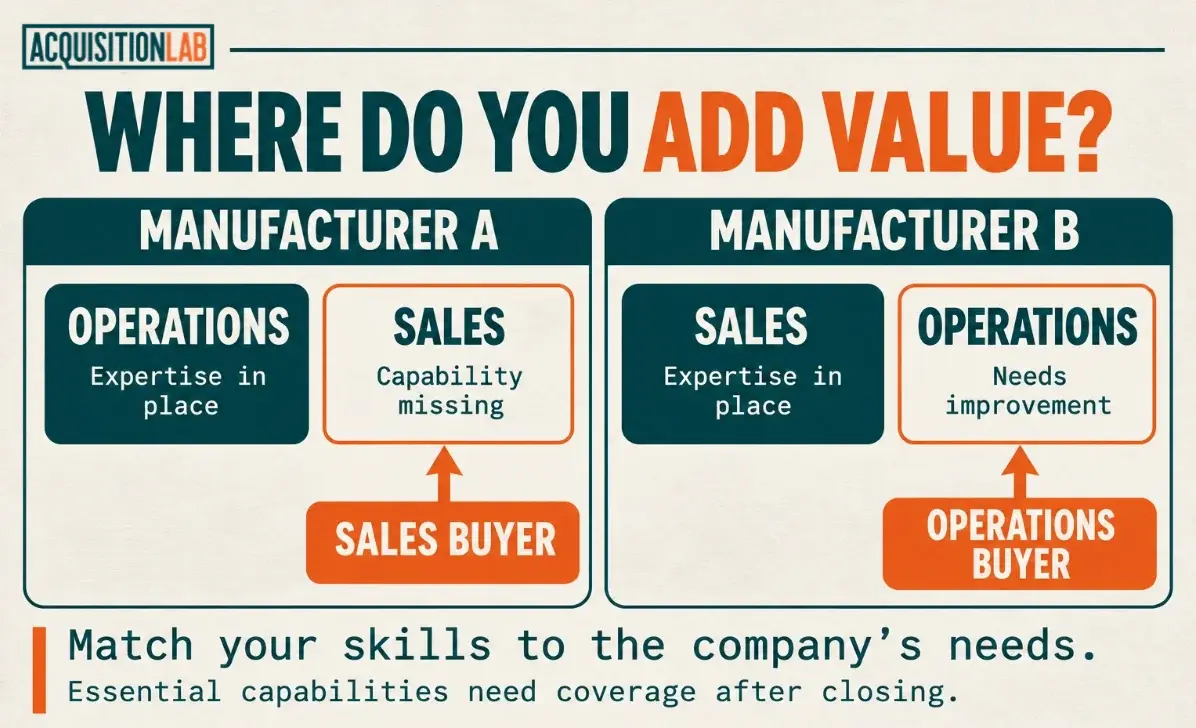
Put that buyer in front of an electronic-components manufacturer, and you’d think he had exactly what the business needed.
So why would I favor a buyer whose strength was B2B sales?
Because the manufacturer already had someone on the team who understood operations. What it needed was someone who could build a sales team and bring in new business.
A buyer doesn’t automatically fit a business just because they bring an impressive background. As the buyer, you need to match what you do well to what this particular company needs.
That means identifying where you can improve the business, which responsibilities you’ll inherit from the seller, and how you’ll judge the work you hire others to do. That’s where business-buyer fit gets more demanding than choosing an industry you know or finding a company with attractive earnings.
What does this business need from you?
The first step is to identify where your experience can improve the business, specifically by connecting something you have already done well to a specific need in the company.
Match your experience to the company’s actual constraints
In the manufacturer comparison, the sales buyer’s experience building B2B sales teams made him a stronger fit for the manufacturer because he could bring in new business while the existing team handled production.
On the other hand, someone who specializes in streamlining operations might bring more value to a manufacturer struggling to schedule production, control costs, or fulfill orders. That just wasn’t the issue in this particular instance.
To understand what you bring to the business, ask yourself:
- Where have I produced measurable results? Identify projects where your work increased revenue, reduced costs, or improved profitability.
- Which successes could I repeat here? Consider what you personally drove and which people, resources, or systems helped you deliver.
- Does this company need what I do best? Pinpoint the problem your experience equips you to solve and why solving it would materially improve the business.
A marketing title tells me less than an explanation of how you reached customers and turned that work into profitable sales. Someone with a finance background may bring valuable analytical skills, but I also want to understand their experience managing people, overseeing a budget, and putting decisions into practice.
You need to test the company’s side of the match just as carefully. A business with minimal marketing efforts might look like an easy growth opportunity, but if it already struggles to fulfill existing orders, bringing in more customers could mean more late jobs and frustrated customers. Before you build an acquisition thesis around sales, establish whether the business can support the sales you intend to generate.
Make sure you want the work you’re qualified to do
There’s a personal question here, too: Even if you are good at this work, do you want to keep doing it? I’ve seen members buy businesses that performed well and still felt miserable as owners. One buyer acquired a lean company, only to realize how much he missed working with a team and connecting to the mission. The business met the criteria on paper, but the actual experience of owning it did not suit him.
As you assess your fit as an operator, articulate the contribution you can make and the work you expect to do each week. Both should make sense for the company and for you.
What work leaves with the seller?
Your plan to improve the business has to account for the work that keeps it running today. The seller may perform essential duties that fall outside the skills you bring. A buyer with a sales or marketing background needs someone who can deliver the work while they bring in new customers.
Identify what the seller actually does
Consider a hypothetical service business where the seller describes her role as “oversight.” A buyer sees a capable crew running the business smoothly and figures he can hire a supervisor to take over. During diligence, he discovers that her oversight includes preparing complex estimates and managing the largest customer relationship.
A newly hired supervisor might manage the schedule perfectly and still lack the experience to price those jobs or resolve those customer problems. The buyer would inherit responsibilities he never included in his ownership plan.
Ask the seller:
- Which decisions require your involvement?
- Who could make those decisions without you, and who already has?
- What happened the last time a project went wrong, and what did you do?
Use the answers to list the essential responsibilities and who handles each today. Include the decisions and relationships behind the seller’s job description, alongside the routine tasks.
Verify who can (and wants to) take over
For each responsibility, identify who will handle it after closing and test whether they have the experience to do it. The distinction between could and has matters. Ask the seller when the proposed successor last priced a difficult job or resolved a customer problem without her help. Those examples tell you more than a confident “I’m sure they can handle it.”
That said, just because an employee has the experience doesn’t mean they’ll want an expanded role. They may know the technical work but have little interest in managing people, handling customer disputes, or taking responsibility for the department. If you’re able to do so before closing, coordinate discussions with key employees through the seller to establish whether they want those duties and what authority they would need.
Assess what they’ll need from you
Let’s say you find an employee who wants to take on some of the seller’s responsibilities and has relevant experience. They may still need substantial support as they move into the role, including technical training you’re not yet equipped to provide.
Before counting on that employee, work out who will provide that training and guidance, and how you’ll assess their progress.
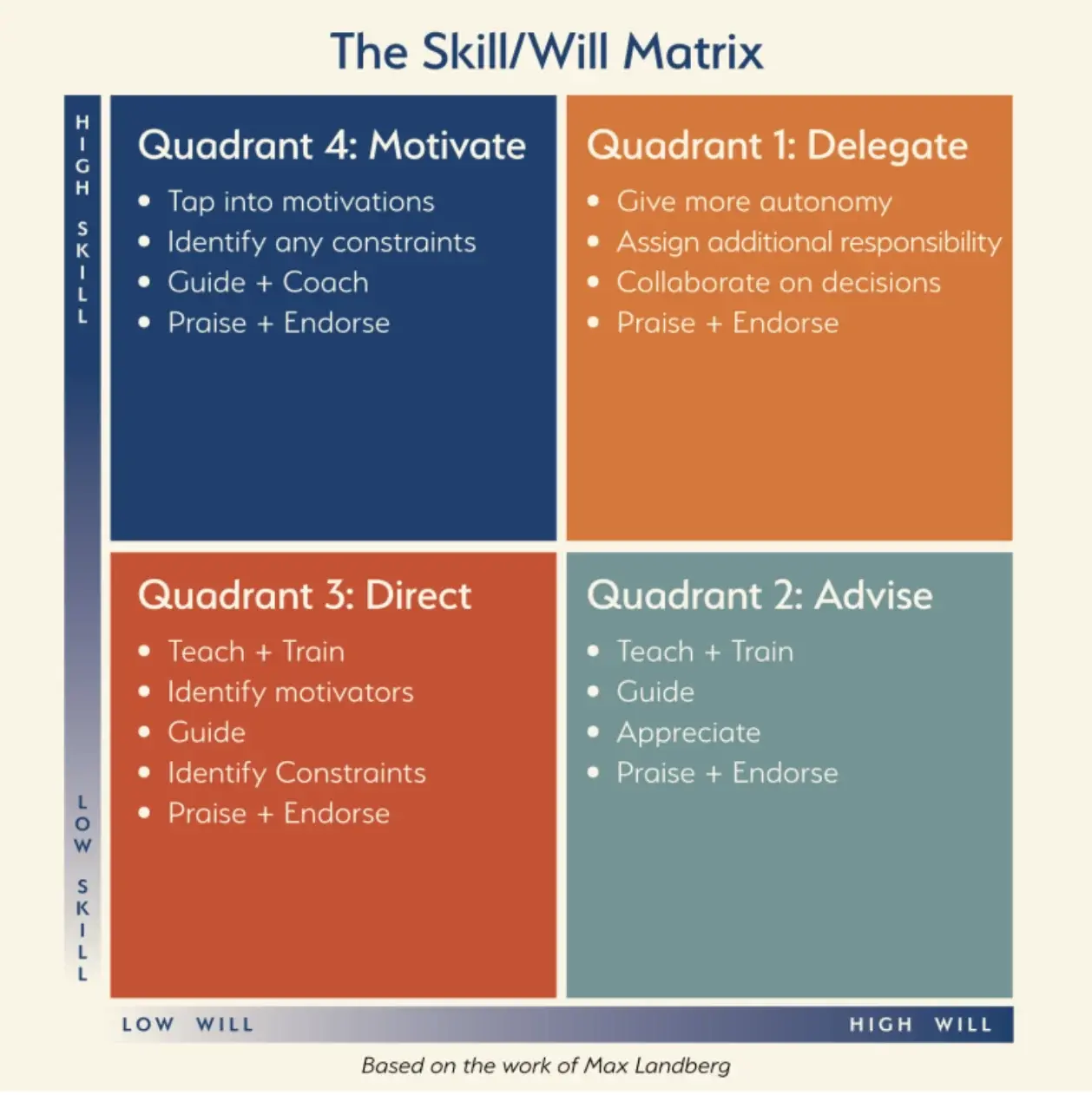
The support an employee needs depends on their skill and willingness to take on the responsibility. Can you provide the guidance, training, or oversight they need? Source: Doris Roach
Account for the support you’re leaving behind
If you’re leaving a large organization, take stock of the people and resources that helped you do your job. You may need to make decisions yourself that a colleague or department used to handle.
I’ve spoken with Lab members who discovered they understood much less about a function than they thought because they had always relied on a particular colleague in a previous role. After the acquisition, that person was no longer available.
You can buy without direct industry experience if your transferable skills address the company’s needs and you have a credible plan to retain and oversee the expertise you lack. A buyer with lead-generation experience in roofing, doors, or windows could help an HVAC company attract customers, provided someone maintains the operational knowledge needed to deliver the work.
Your replacement plan needs to account for what the team will need from you, as well as what you expect from them. Once you understand those demands, you can judge whether the actual ownership role still fits what you can offer.
You still have to judge the work
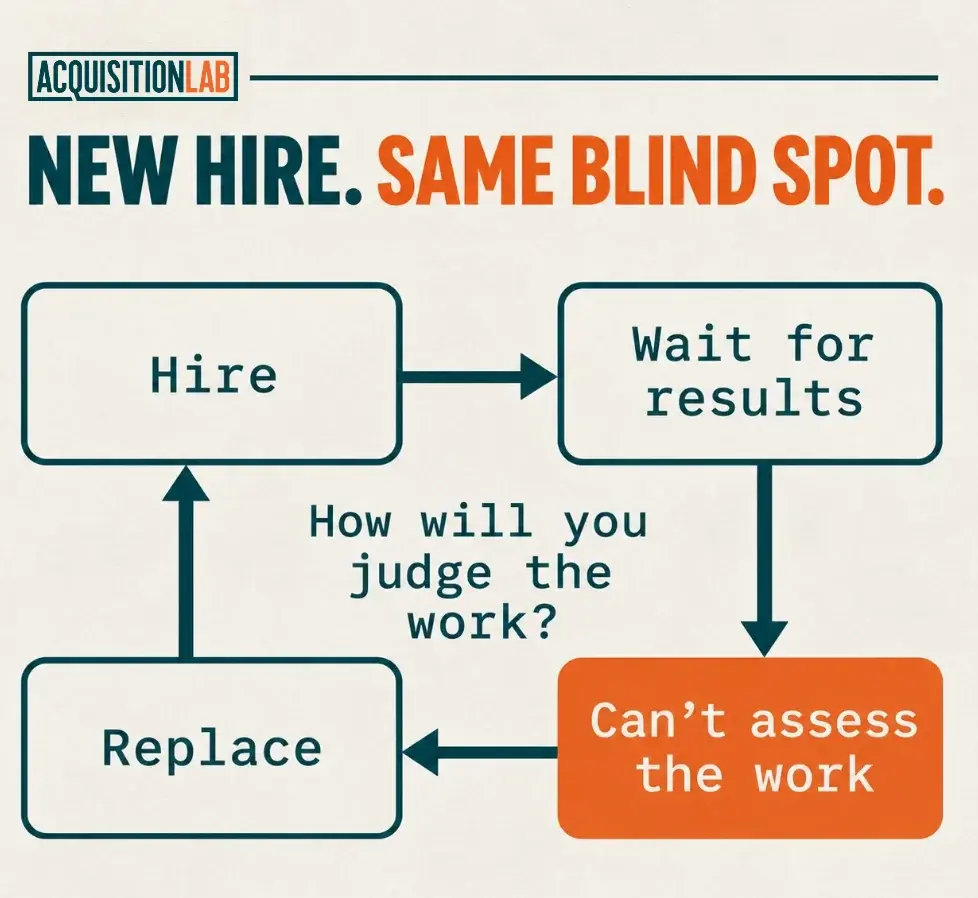
Let’s say you can afford to hire someone with the experience you lack. That helps cover the work, but how will you know whether they’re doing it well?
A Lab member once bought an online business expecting to figure out a part of it he was unfamiliar with. Instead, he found himself relying on other people without understanding enough to judge their work. Because he couldn’t accurately gauge their performance, he’d give someone roughly three months, decide the approach wasn’t working, and bring in someone else.
You can see how exhausting that becomes. Each replacement means another stretch of waiting, without necessarily getting any better at recognizing what’s wrong.
Is the person doing poor work, does the strategy need more time, or does something else need to change?
That’s why I push back when buyers tell me they’ll hire an agency, run ads, or learn the skills behind their growth strategy after buying. Of course people can learn. But when you take on personally guaranteed debt, you’re committing to repayments while you figure out whether you can make that strategy work.
Let’s say you hire a marketing expert who brings in just a few sales. You might blame the marketing, but it could be another issue. Maybe customers don’t want the offer, take longer to decide than you expected, or aren’t getting timely responses from the business. Replacing the marketer won’t resolve those problems. You need enough understanding, or help from someone who has it, to investigate before you decide what to do next.
Establish how you’ll judge performance before you hire
Before counting on a hire or vendor to fill a gap, ask yourself:
- What does good performance look like? What should this person accomplish, and how long should it reasonably take?
- What evidence will I use? What will you review to see whether the work meets your expectations and how will you catch problems before they grow?
- Who can help me judge the work? If results fall short, who can independently assess the person’s explanation and help you decide whether to give them more time or change course?
Be careful about what you count as success, too. A sales team might bring in more orders while committing the company to jobs it can’t fulfill profitably. A production team might hit its output target while producing defects that employees have to fix. In either case, the headline number can look good while the extra work leaves the business with less profit.
You don’t have to perform every job yourself, but you still need a way to judge the work. Before buying, identify where you’ll need help setting expectations, checking explanations, and deciding when to intervene. Hiring someone covers only part of that responsibility.
Can you close your capability gaps?
Finding a gap doesn’t automatically mean you should walk away from a deal. It does mean you need to work out how you’ll cover it, whether you learn parts of the job, retain someone who knows it, or hire an experienced leader. Each option asks something different of you.
Learn enough to recognize good work
If you can spend time alongside the seller or employees during an agreed transition, use it to understand how they make decisions. Watch how they handle a difficult estimate or a customer complaint. Where practical, do parts of the work yourself so you can recognize what goes wrong and when someone needs help.
Be realistic about how much you can learn, though. A few weeks beside an experienced operator won’t give you years of technical knowledge, and some duties require qualifications you don’t have. Before relying on a transition period to close the gap, work out what you can reasonably learn and who will handle the responsibilities you can’t yet take on.
Put expertise in place, and establish who oversees it
Let’s say you don’t have the experience to oversee production yourself.
You might have a manager who could take it on, or you could hire someone who has run that kind of operation before. If you’re counting on a current employee, have they already made those decisions without the seller’s help, and do they actually want the job? If you need someone from outside, find out who’s even available. Budgeting for a hire doesn’t mean you’ll find the person you need.
Once you find that person, think about why they would stay. I’ve discussed offering a key employee a small equity interest when their knowledge matters to keeping the business running. Equity won’t appeal to everyone, and it won’t make sense in every deal. That said, if your ability to run the company depends on someone staying, you need to understand what would motivate them to do the role and do it well.
You’ll still have someone to manage, even if you no longer manage the technical work yourself. Having an operating leader simply moves your oversight up a level. You still have to choose that leader, agree on what decisions they can make without you, and know enough about their performance to recognize when something needs attention. You can bring in an independent expert to help with that judgment. Just make sure your plan also answers what you’ll do if the person you rely on leaves.
The Center for Creative Leadership’s delegation guidance provides a useful starting point.
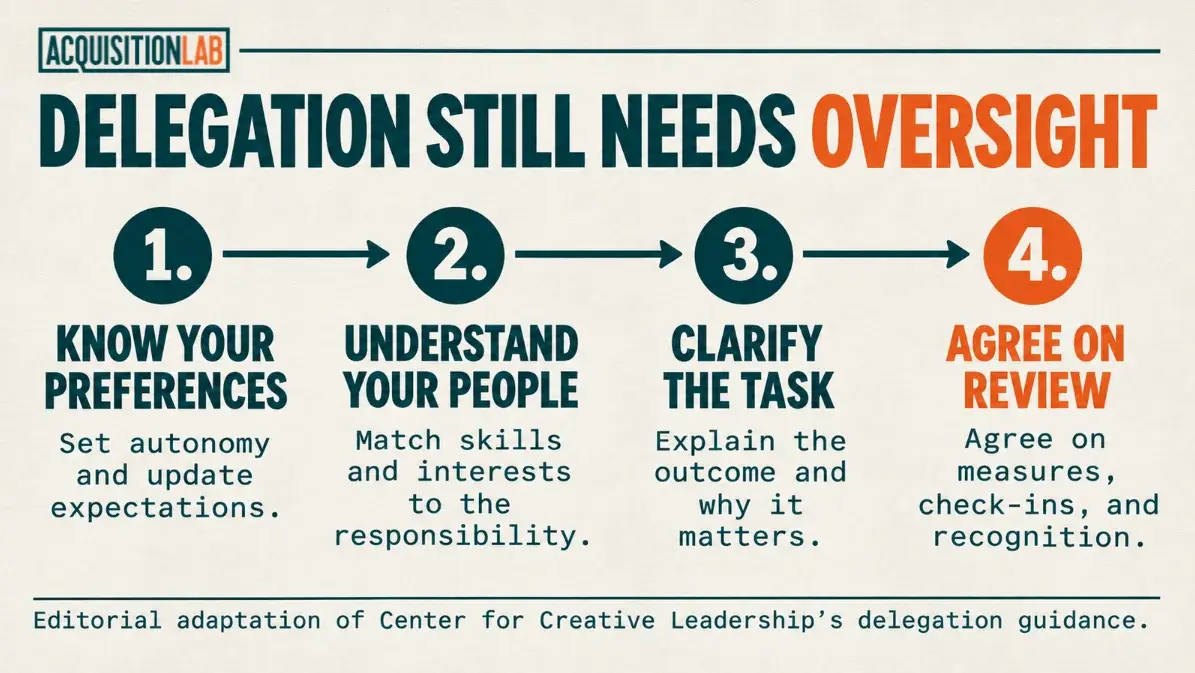
Source: Center for Creative Leadership
Test whether the arrangement works for the deal (and for you)
Once you find the right person, the business has to support the cost. Consider a hypothetical company that generates $600,000 in annual earnings before acquisition loan payments, assuming you work in the business and take over the seller’s duties. Annual loan payments use $300,000, leaving another $300,000.
Now suppose you hire an additional operating leader for $150,000 a year, including employer costs. You have $150,000 left before taxes, reinvestment, and reserves. That hire uses half the money that remained after loan payments, and you still work in the company. This assumes the original earnings figure doesn’t already include the cost of the new position.
The hire may well be worth it, but you need to evaluate the acquisition with that expense included, rather than treat it as something you’ll work out once you own the business.
Before committing, answer four questions:
- What essential work must continue after the seller leaves?
- Which responsibilities can I handle, based on my experience?
- Who will handle the rest, and how will I judge their performance?
- Can I secure and afford that arrangement while leaving myself time to contribute what this business needs?
You won’t have every answer before submitting an LOI, but you should have enough to explain how the arrangement could work. During diligence, replace assumptions with evidence about the people, responsibilities, and costs you’re counting on.
Decide whether you fit the job that remains
In the original manufacturer example, the B2B sales buyer could bring something valuable because the business already had operational expertise in place. If it lost that expertise after closing, the buyer might spend his days sorting out production problems instead of building the sales team the company needed.
Someone once asked me whether a buyer could make ownership work by accepting two or three miserable years. Even the right business will test you, so I’m less concerned with how much hardship you’re willing to endure than whether your skills and judgment will help you handle the problems this particular business puts in front of you.
You don’t need to arrive with every answer, but you do need to know how you’ll reach a sound decision. Before buying, work through who you’ll turn to, how you’ll judge their advice, and what you’ll do if they’re unavailable. Naming the person you plan to hire is only the beginning of that answer.
Ready to take the next step?Join Acquisition Lab
Get the frameworks, community, and expert guidance to find, evaluate, and close your first acquisition.
Apply Now
Join us at sea · January 2027Acquire It Summit 2027
Several days of focused programming, real deal breakdowns, and relationship-building with the ETA community aboard Virgin Voyages' Brilliant Lady. Sailing from Miami to Key West and Bimini.
Reserve Your Cabin