
I’ve had this same conversation thousands of times at this point.
A buyer gets on a call, they sound frustrated, and within two minutes they land on the same diagnosis: “I just need more deal flow.”
I get why that feels true. Searching is tedious. Broker lists feel like a black hole. You spend nights scrolling listings and you start believing the problem is volume.
If you could just see more deals, you would finally find the one.
But most of the time, deal flow isn’t the real issue. It’s the story buyers tell themselves when they don’t feel ready to take action.
You Can’t Find What You Can’t See
I learned that the hard way in a totally unrelated context: putting my kid to bed.
We used to do those little “find it” games. I’d say, “Go find a baby carriage,” and he would just stare at the page, getting more and more irritated, because he didn’t actually know what a baby carriage looked like. He had this vague, hopeful logic that adults love: I’ll know it when I see it.
No, you won’t. Not if you haven’t trained your eye.
That’s the buyer who thinks the answer is more listings.
The most underrated accelerant in a search is clarity — not just "my buy box is $1–3M in these three industries." That's necessary, but it's not enough. What actually speeds up your search is knowing what the business needs to look like in real life.
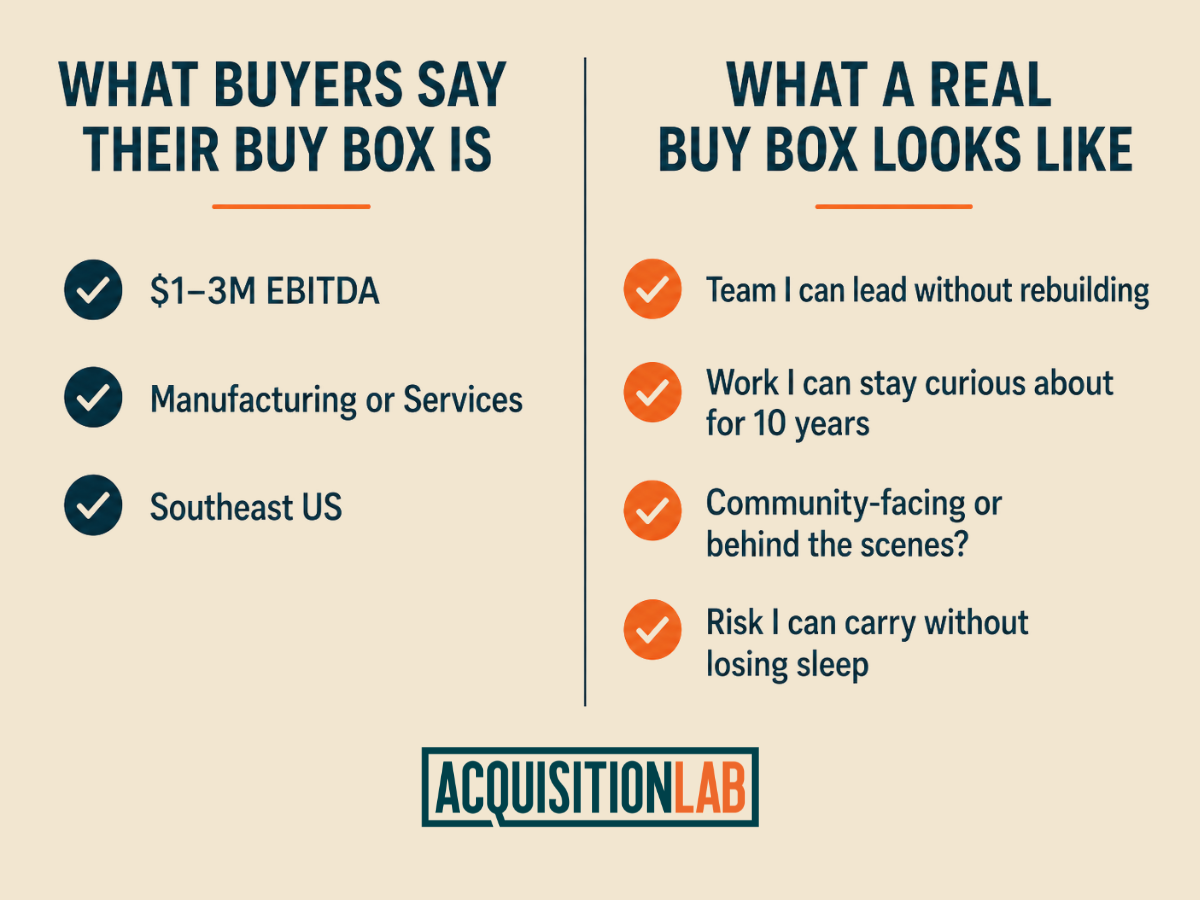
Acquisition Lab member Joe Wechsler learned this firsthand. Coming from consulting, he was comfortable evaluating almost any type of business. At first, that felt like an advantage. In reality, it made it impossible for brokers, advisors, and friends to help him. When you're open to everything, nobody knows what to send you.
Once Joe narrowed his focus and got specific, not just an EBITDA range, but a business that fit the type of owner he wanted to become, opportunities started appearing in places they hadn't before.
He wasn’t struggling with a lack of deal flow – just clarity.
Do you want to lead a team, or build one from scratch under debt and payroll pressure? Do you want to be the face of a community-embedded business, or something more operational and transactional? And maybe most importantly: do you care about the work itself?
That one surprises buyers because it sounds soft. But I've watched people buy the perfect business on paper with growing, great margins and be miserable. They stop caring, stop leading, and start resenting the very thing that was supposed to be their freedom.
A job you don't like is a problem you solve by quitting. A business you don't like is a one-way decision.
The Real Constraint: You
Once you have clarity, the next challenge is your own brain.
Buyers love to blame external factors because it feels more controllable. "The deals are bad." "The brokers are useless." "Nothing pencils." Sometimes those things are true. Often, they're a cover story for a more uncomfortable reality: you're filtering every opportunity through fear.
First-time buyers tend to live in hypervigilance. They look at a listing and immediately see everything that can go wrong. Owner dependency. Key employees leaving. Customer concentration. A personal guarantee. I'm a hypervigilant person by nature, which has served me well. But it can also paralyze you if you don't manage it.
One reframe that helped me: possibility versus probability.
Could it happen? Sure.
Is it likely to happen? That's a different question.
If you don't train yourself to separate those two, you'll treat every hypothetical risk like a certainty and never move.
So here's a brutal question most buyers avoid: do you actually want to buy a business? Not whether you like the idea of being a business owner. Do you want the actual reality, with the inherent risks that don't go away?
Acquisition Lab member Shane Ehrsam got an unexpected opportunity to answer that question when he was laid off from his corporate job. Like many buyers, he initially focused on finding the right business. What he discovered was that the bigger question was whether he wanted the realities that came with ownership.
Nine months after joining Acquisition Lab, he acquired North Texas Trailers. It wasn't glamorous. It wasn't something he'd spent years dreaming about. But it was a good business he believed he could improve.
Since then, he's expanded the team, added benefits, grown revenue, and begun laying the groundwork for geographic expansion. Looking back, the defining decision wasn't choosing trailers. It was deciding he wanted to be an owner.
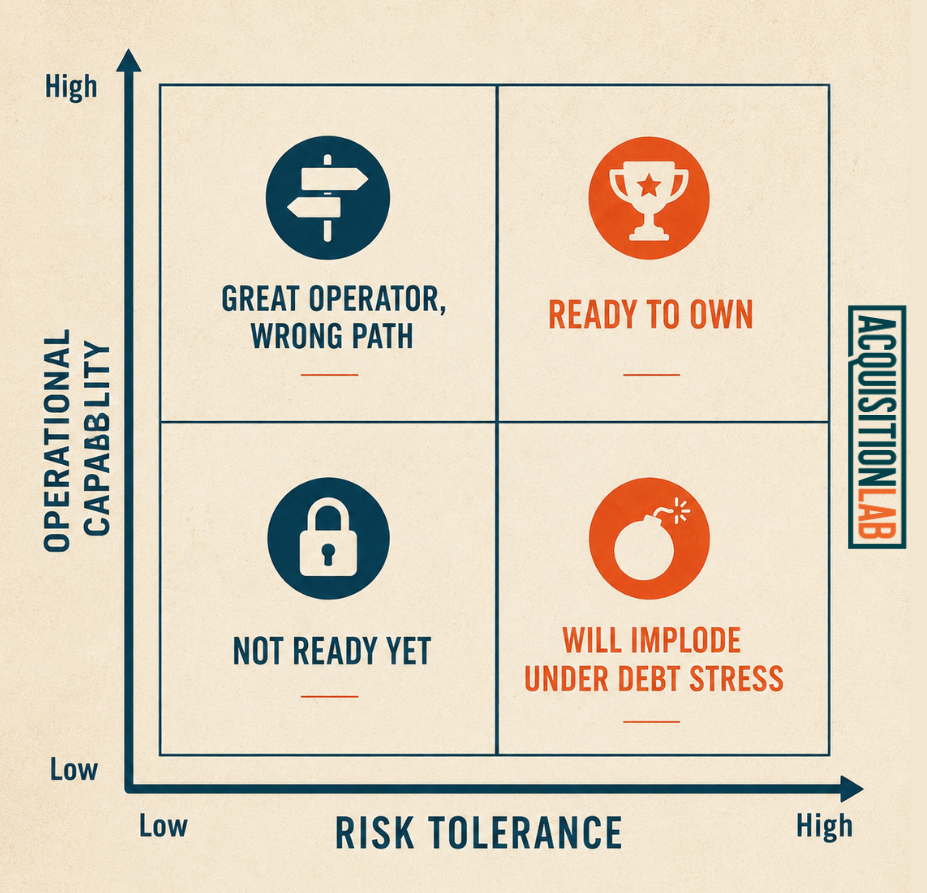
Most buyers spend far more time evaluating businesses than evaluating whether they're truly prepared for ownership itself. Because some risks aren't specific to a deal — they're just part of ownership. Employees can leave. Key customers can leave. Markets shift. Debt can feel heavy. The first year can be brutal.
I've watched people implode from debt stress. Not because they were incompetent, but because they didn't know what it would feel like to lie in bed at night owing millions. They could run the business. Their nervous system couldn't carry the weight.
The LOI Is the Line in the Sand
People say they need more deal flow, but the reality is they aren't putting offers out.
They hide behind research. They treat LOIs like marriage proposals.
An LOI is a tool. It's how you move a deal from vague curiosity into a real process where you can get the information you actually need. If a deal looks good on initial information, and you can articulate what would need to be true after getting more access: put it under LOI.
If new information contradicts what you were shown post-LOI, that's when you renegotiate. Adjust price, terms, structure – or walk. An LOI based on available information is not a blood oath.
The buyers who close are the ones whose confidence in themselves outweighs their fear of the unknown. You will never be 100% confident. If you're at 85% and waiting for the last 15%, you're waiting for a feeling that won't arrive.
Acquisition Lab member Lucas Phillips learned this firsthand. When he acquired Newark Auto, a 120-year-old manufacturer of classic car carpets and interior components, he had a thesis around modernizing old-school consumer products businesses. What he didn't have was a complete roadmap.
Since acquiring the company, he's digitized decades of proprietary patterns, implemented CNC cutting technology, expanded direct-to-consumer sales, and completed multiple acquisitions that transformed the business beyond what he originally purchased. None of those opportunities were visible from the outside.
As Lucas put it: "You never know what you're getting into when you get into it. Once you get into it, then you start to see what you really need to do."
Many of the best opportunities only become visible after you've taken the first step.
Relationships Beat Refreshing Listings
If your deal flow strategy is refreshing aggregator sites every day, deal flow is your problem.
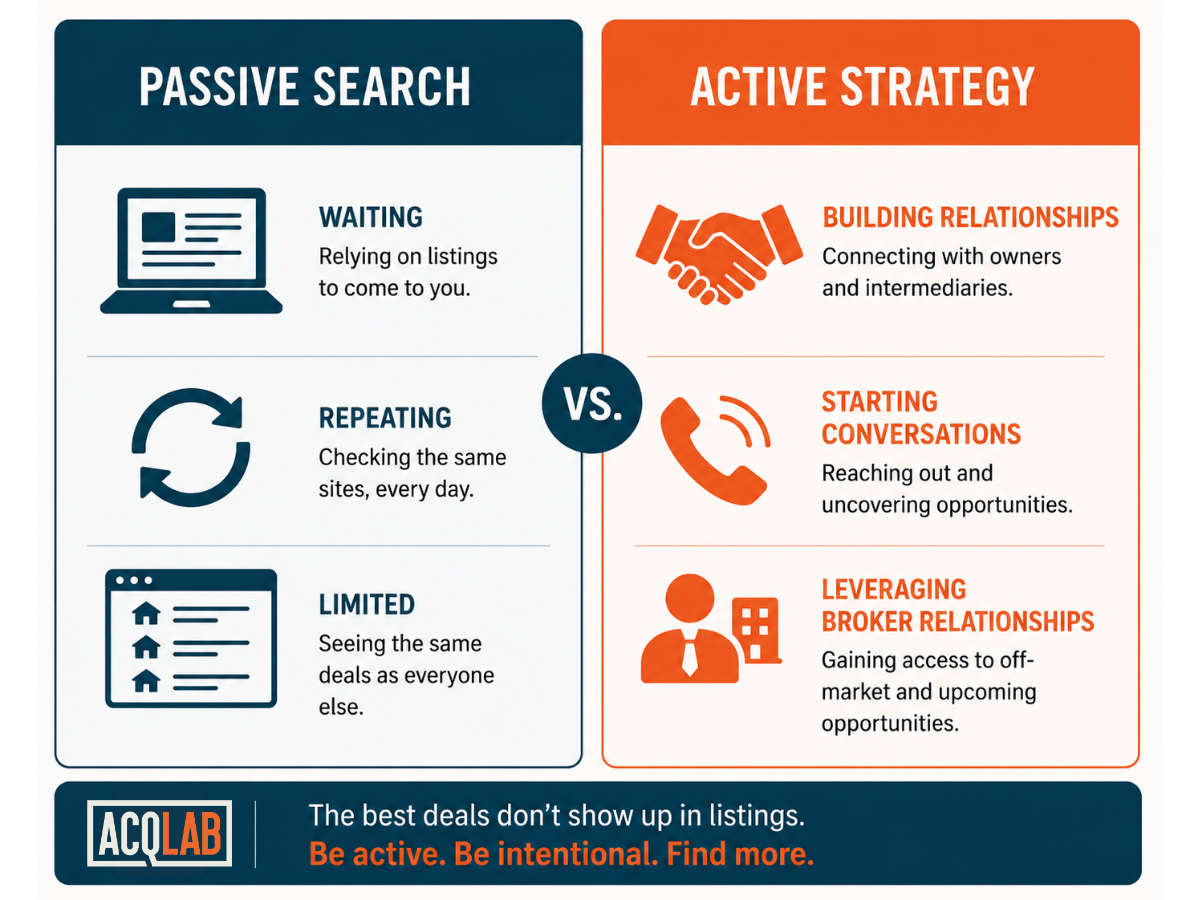
Aggregators are a starting point, not a strategy. Relationships are a strategy. Brokers don't reward the person who checks listings. They reward the buyer who shows up professionally, moves quickly, communicates clearly, and respects everyone's time.
No offer is insulting. Leading someone on is insulting.
If you want better deals, build a reputation for being a serious buyer with conviction. Move fast. Ask for what you need. Kill deals quickly when they don't work. That's how you earn access to the deals that never hit the public feeds — and it's the kind of judgment and accountability that the right community will help you sharpen.
Once you understand that, you stop obsessing over deal flow.
You start obsessing over clarity, self-management, and taking action.
That's what actually gets deals done.
Ready to take the next step?Join Acquisition Lab
Get the frameworks, community, and expert guidance to find, evaluate, and close your first acquisition.
Apply Now
Join us at sea · January 2027Acquire It Summit 2027
Several days of focused programming, real deal breakdowns, and relationship-building with the ETA community aboard Virgin Voyages' Brilliant Lady. Sailing from Miami to Key West and Bimini.
Reserve Your Cabin