
Warren Buffett has a line: "You pay a very high price in the stock market for a cheery consensus."
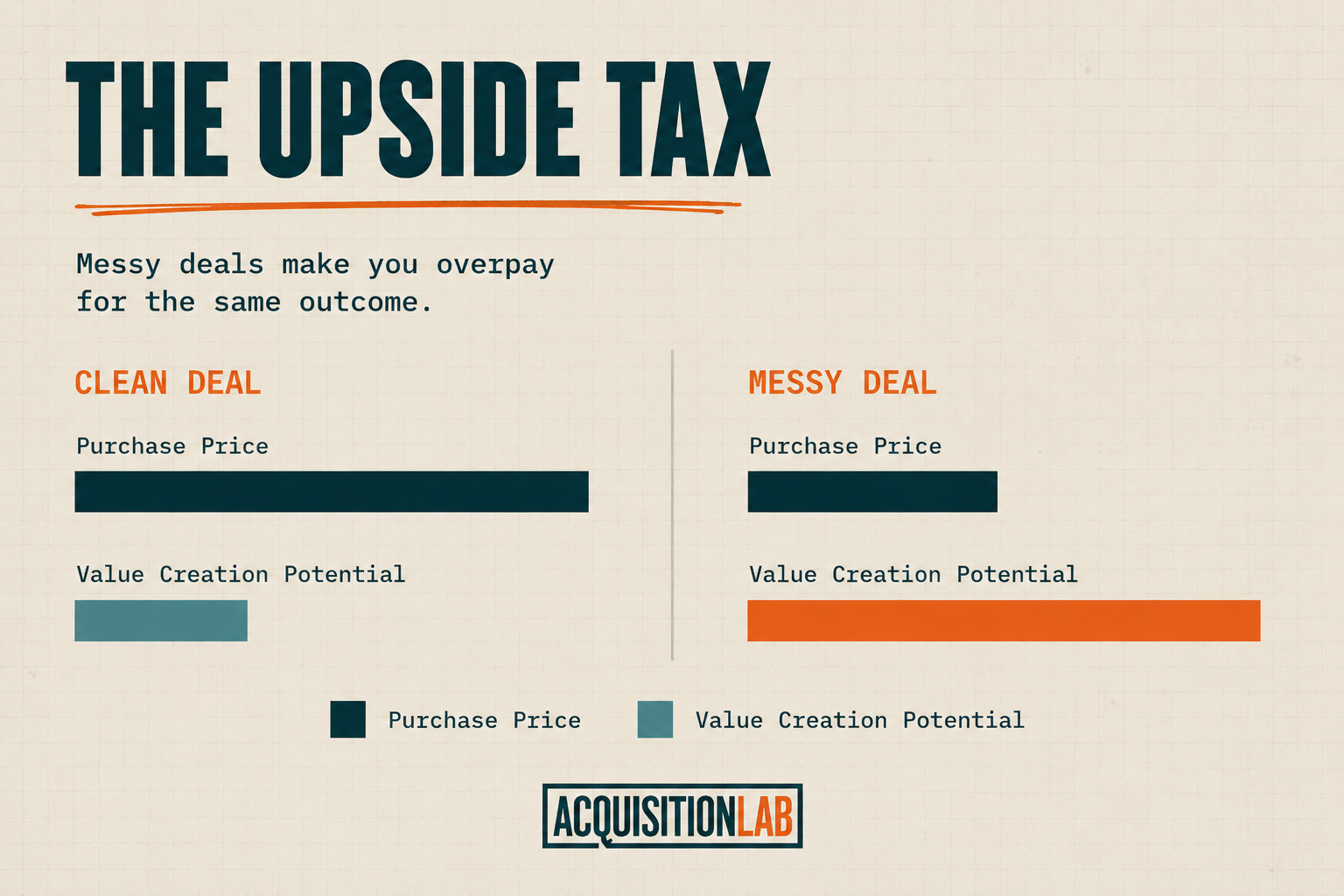
The acquisition version: the cleanest-looking deals are often the most expensive ones.
And the messy ones, the ones that make your stomach hurt a little, are often where the real value hides.
I've watched this play out more times than I can count.
Buyers spend years trying to avoid making a mistake. Which makes sense. They're signing guarantees. They're wiring life-changing amounts of money.
But what happens sometimes is that the fear of making a bad acquisition becomes greater than the desire to make a good acquisition.
And that's when good deals die for the wrong reasons.
Mistake #1: Treating Ownership Challenges Like Deal Killers
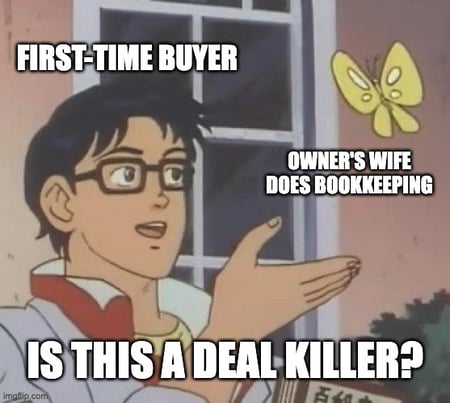
I've seen buyers walk away because the owner was too involved, there wasn't a management team, or customer concentration felt too high (without them ever really understanding the customer).
Those can be legitimate concerns. I'm not saying they aren't risks.
What I am saying is that many of those businesses go on to become very successful acquisitions for the right buyer.
The thing buyers miss is that ownership challenges and deal killers aren't the same thing.
Here's the question I ask when a member is spiraling on a risk: Is this a risk of THIS business, or is it a risk of buying A business?
Key employee dependence? That's buying a business.
Customer concentration? That's buying a business, and a day-one growth opportunity.
Needing to give raises to retain staff on day one? Ownership.
Every business you'll ever look at has some version of these challenges. The "clean" deals, the ones with no key person risk, perfectly distributed revenue, a seller who's already irrelevant, those exist. They're just priced accordingly.
You don't find edge in perfect businesses. You find it in businesses where the problems look scarier than they are.
And here's the harder truth: if you can't get comfortable with the basic risks of buying a business, it's not that you've found a deal killer. It's that you don't actually want to buy a business. That’s okay. Just be honest about it earlier.
Mistake #2: Forgetting to Underwrite Yourself
I once pursued a deal I knew, deep down, wasn't the right fit for me.
I could have made it work. But it took way more time than it should have, and I missed things in diligence because I wasn't asking the right questions. I didn't have the technical knowledge the business needed. I was driven by the hole it was filling in our growth strategy instead of recognizing it wasn't a good fit for me as an operator.
That's the part buyers almost never audit.
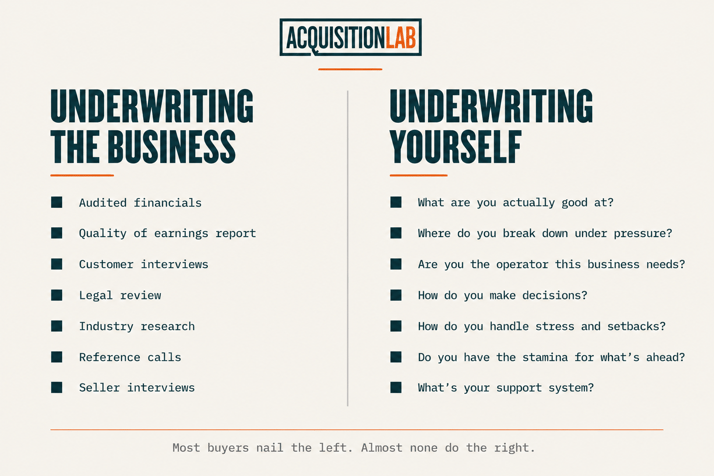
They spend months on the business. Audited financials. Customer interviews. Quality of earnings reports. Legal review. Industry research. Reference calls. All of it pointed at one question: is this business what it says it is?
Good. That matters.
But the biggest variable isn't the historical financials. Those can mostly be understood through diligence.
The real deal killer is execution after closing, and no amount of due diligence tells you whether you're the right person to do it.
I see this pattern constantly. A buyer assumes they'll have some version of a fix for the areas of concern. But unless you've got demonstrable, repeatable experience solving that specific type of problem, "I'll figure it out" is not a diligence finding. It's a hope.
So before you close, ask yourself the harder questions:
- Can you lead people who didn't choose you and who liked the last owner just fine?
- Can you make decisions every day with incomplete information and no one to defer to?
- Can you handle the first 90 days when everything feels broken and the seller has already left the building?
Then turn them inward:
- What are you actually good at?
- Where do you break down under pressure?
- What kind of operator are you, and is that the kind of operator this business needs?
Mistake #3: Believing More Diligence Creates Certainty
Smart buyers fall into this one hardest.
One more report.
One more customer call.
One more financial model.
One more question for the seller.
The belief underneath all of it: “If I just do enough diligence, I'll know for sure.”
You won't. And the sooner you make peace with that, the better buyer you become.
Here's what I tell members: You're only ever going to be about 85% sure you should take the leap. The other 15% is a blind leap of faith in yourself.
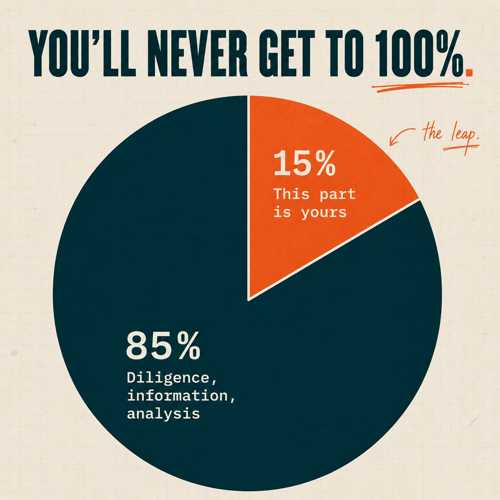
The best buyers I've worked with didn't wait until it felt safe. They set a close date, built their transition plan, and started making decisions as owners before they technically were one. They stopped asking "should I do this?" and started asking "how do I make this work?"
At some point that process stops informing the decision and starts feeding the anxiety.
The goal of diligence isn't to eliminate uncertainty. It's to get clear on whether you're willing and capable of owning the challenges that remain.
Information gets you to the door. Judgment gets you through it.
The Mistake Underneath All Three
Read those three mistakes carefully and you'll notice something.
They're the same fear under three different names.
Buyers who walk away from good deals aren't evaluating deals wrong. They're evaluating the wrong thing. They're holding businesses up against an impossible standard, zero uncertainty, zero problems, zero discomfort, instead of asking the only question that actually matters:
Am I willing and capable of owning what's in front of me?
The buyers I've watched build real wealth through acquisition aren't the ones who found a perfect deal. They're the ones who looked clearly at what was in front of them, problems and all, and decided they were capable of owning it.
That's not a leap of faith in the business. It's a leap of faith in yourself.
Ready to take the next step?Join Acquisition Lab
Get the frameworks, community, and expert guidance to find, evaluate, and close your first acquisition.
Apply Now
Join us at sea · January 2027Acquire It Summit 2027
Several days of focused programming, real deal breakdowns, and relationship-building with the ETA community aboard Virgin Voyages' Brilliant Lady. Sailing from Miami to Key West and Bimini.
Reserve Your Cabin