During due diligence, you can run a customer concentration analysis and still miss major risks hiding in plain sight.
Sophisticated buyers know to request customer revenue reports, identify the largest accounts, and calculate how much revenue depends on the top five customers. If the percentages look reasonable, they move on.
The problem is, those percentages can be accurate and still tell an incomplete story.
Over the years, I've seen several deals where a business appeared to have a diversified customer base. The revenue reports showed multiple customers, but a closer look revealed that several belonged to the same corporate parent.
What looked like several independent revenue streams could actually represent one much larger exposure.
The buyers weren't necessarily overlooking customer concentration. They were overlooking what the report couldn't tell them.
That's just one of four customer concentration mistakes that can catch even experienced buyers off guard. Here's what I'd encourage you to investigate before those blind spots put your acquisition at risk.
Mistake #1: Assuming Your Biggest Customers Are Independent
The first mistake is assuming that because customers appear as separate accounts on a revenue report, they represent independent sources of revenue.
Imagine you're evaluating a business with $5 million in annual revenue. Its three largest customers look like this:
- Customer A: $600,000, or 12% of revenue
- Customer B: $500,000, or 10%
- Customer C: $400,000, or 8%
No single customer accounts for more than 12% of sales, so you might look at that report and feel comfortable.
Later in diligence, you discover that Customers A, B, and C are subsidiaries of the same corporate parent. Together, they account for $1.5 million, or 30% of the business's revenue.
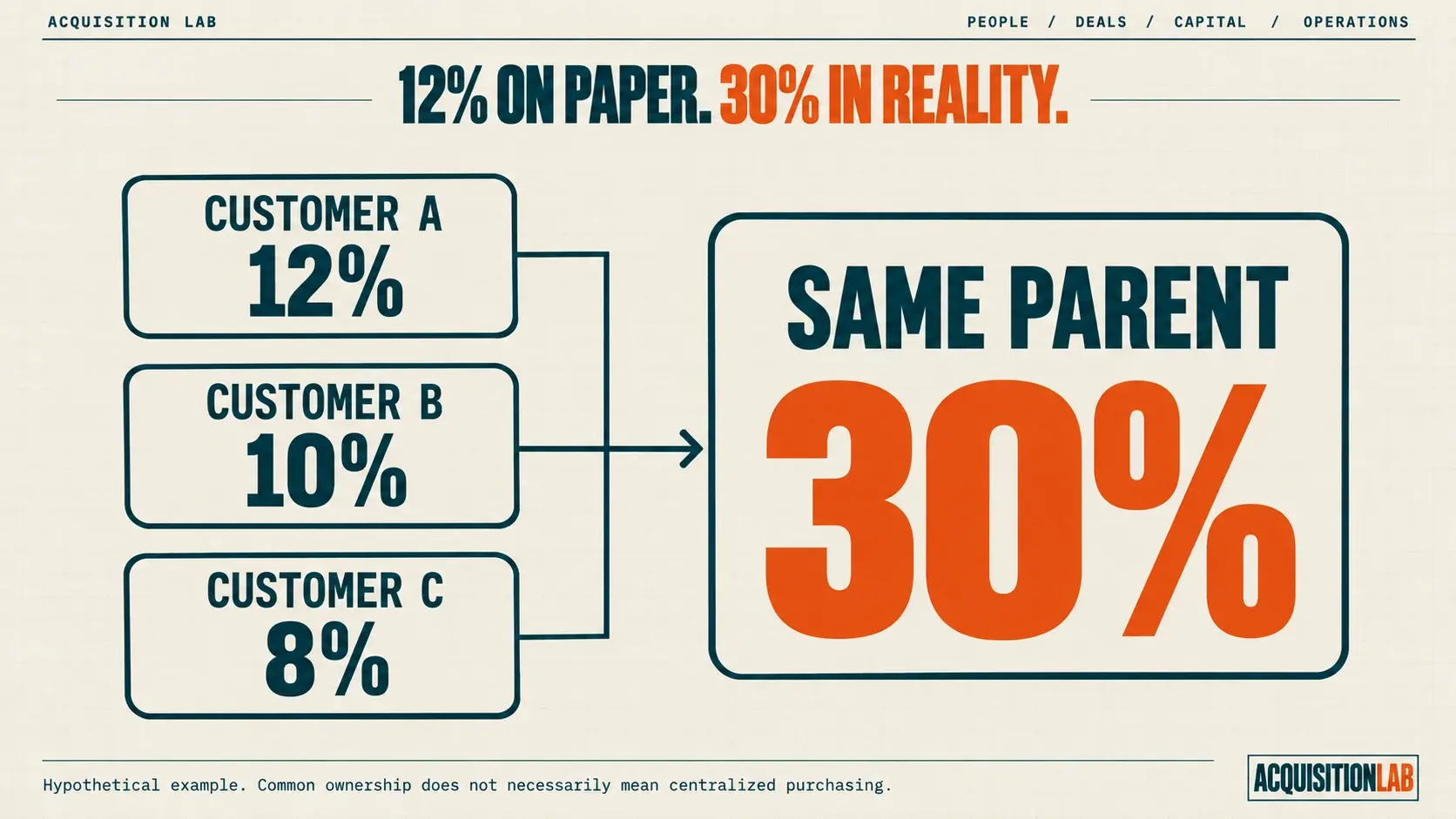
Nothing in the customer revenue report was inaccurate. Each account generated the revenue shown. However, what the report didn't reveal was that all three customers belonged to the same corporate parent.
This is why I think buyers need to look beyond the standard customer concentration report.
Customer concentration risk is the exposure a business faces when a meaningful share of its revenue depends on a limited number of customers or purchasing relationships. You can calculate a customer's concentration ratio by dividing its revenue by the business's total revenue over the same period, then multiply that by 100 to get a percentage.
Customer Concentration (%) = (Customer Revenue ÷ Total Revenue) × 100
That said, that calculation only tells you how concentrated revenue is at the individual account level. When several accounts belong to the same corporate group, I'd want to calculate their combined share as well.
Even public-company accounting rules recognize the importance of identifying related customers. Under ASC 280’s major-customer disclosure guidance, companies treat entities known to be under common control as a single customer when assessing whether they account for 10% or more of revenue.
While those rules govern public-company reporting rather than private business acquisitions, the underlying principle is relevant to buyers: separate customer accounts don't necessarily mean separate sources of revenue risk.
Once you've identified those relationships, the next question is: Who actually decides where those companies spend their money?
Mistake #2: Confusing Separate Customer Accounts With Separate Purchasing Decisions
The second mistake is assuming that customers under the same corporate parent necessarily make purchasing decisions together.
Imagine three subsidiaries operating in different regions. Each has its own management team, negotiates its own supplier contracts, and decides independently who to buy from. The subsidiaries may share an owner, but ultimately, losing one customer's business might have little effect on the others.
On the other hand, imagine those same subsidiaries operate under a centralized procurement department. The parent company negotiates vendor agreements, determines which suppliers are approved, and can require all three subsidiaries to consolidate their purchases. That's a very different situation.
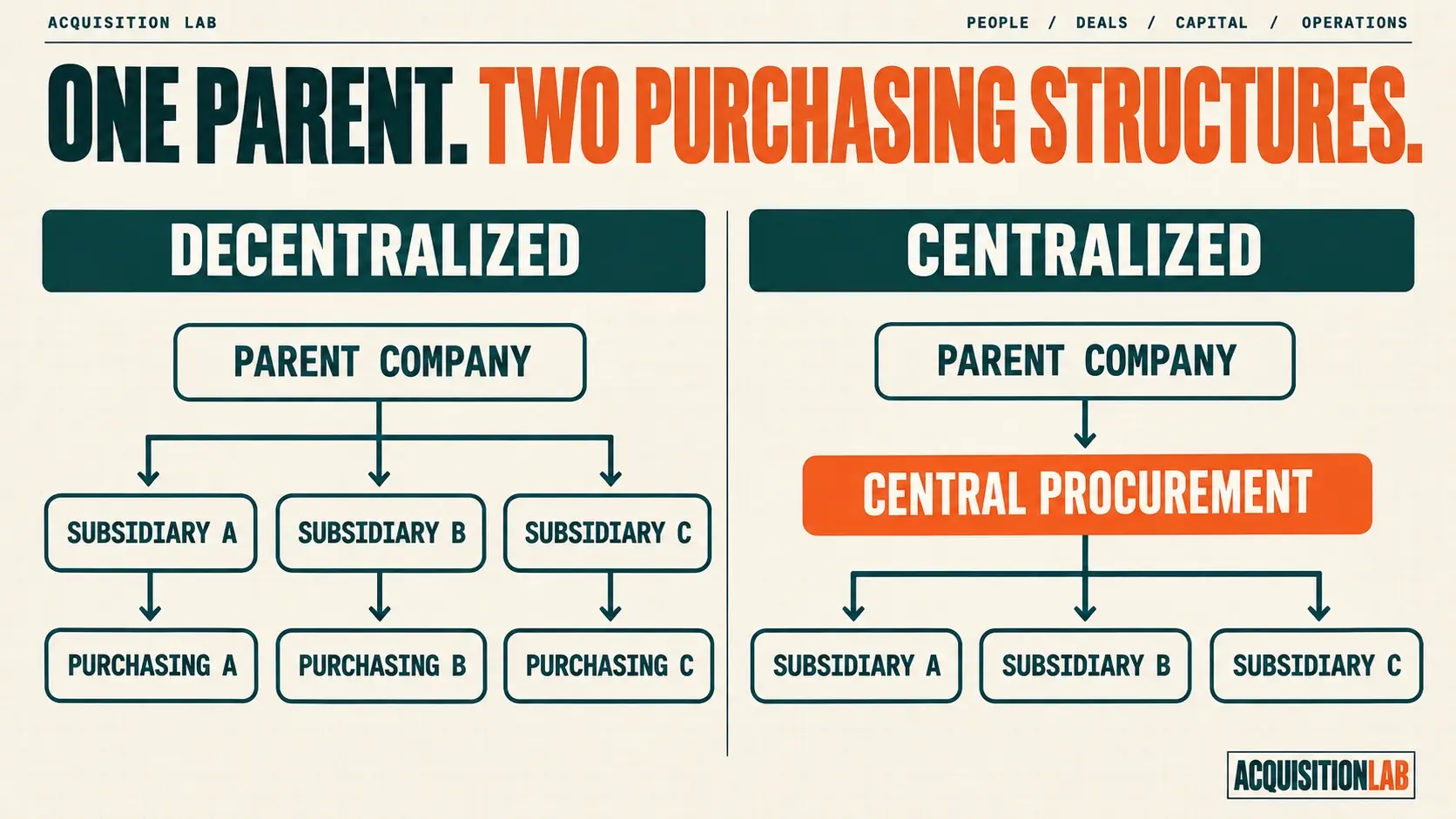
It’s important to remember that corporate ownership and purchasing authority aren't the same thing. I find it useful to think about customer concentration at three levels:
- Account concentration: How much revenue comes from each individual customer?
- Corporate concentration: How much revenue comes from customers under common ownership?
- Decision-making concentration: How much revenue could be affected by one purchasing authority?
The same 30% revenue concentration can represent very different levels of risk depending on who controls the purchasing decisions.
Mistake #3: Treating a 30-Year Customer Relationship Like a Guarantee
The third mistake is assuming a long-standing customer relationship is a reliable predictor of future revenue.
Let's say you're buying a business that has served the same major customer for 30 years. That’s quite a track record. The seller probably knows the customer's leadership team, understands its operations, and has built a reputation for delivering consistently.
It’s easy to look at that history and assume the relationship will continue, but there are factors outside of sheer good will that can still disrupt the strongest customer relationships:
- A merger or acquisition: The customer merges with or is acquired by another company.
- Existing supplier relationships: The new parent company already has a preferred supplier.
- Centralized purchasing: The combined organization consolidates purchasing decisions across its subsidiaries.
- Changes in decision-makers: The relationships your seller spent decades building no longer carry the same influence with the people making purchasing decisions.
The business hasn't done anything wrong. Its products haven't deteriorated, and the customer hasn't suddenly become dissatisfied. The circumstances have simply changed.
We recently had an Acquisition Lab member evaluating a business where a significant customer was involved in merger discussions. I don't know how that situation will ultimately play out, but it's exactly the kind of development that deserves a closer look before buying a business.
- Could the merger affect the customer's purchasing decisions?
- Is there a risk of supplier consolidation?
- How much revenue could disappear if the new organization chooses a different vendor?
Another important thing to investigate is why the customer has stayed for so long. Is it primarily because of the seller's personal relationships, or because switching suppliers would be expensive, disruptive, or difficult? A customer with an entrenched supplier relationship may be more likely to stay than one that could switch vendors with little disruption or inconvenience.
A customer that's been around for 30 years may be an excellent sign, but 30 years of purchasing history tells you what happened under the old circumstances. It doesn't guarantee what happens when those circumstances change.
Mistake #4: Measuring Revenue at Risk Instead of Earnings at Risk
The fourth mistake is focusing on how much revenue a business could lose without calculating what that loss would do to its earnings.
Let's return to our hypothetical $5 million business. Assume it generates $1 million in EBITDA, and those three related customers account for $1.5 million of annual revenue.
Now imagine the parent company consolidates purchasing, and the business loses all three accounts. That's a 30% revenue decline. That’s a significant loss as is, but the effect on earnings can be substantially worse.
To understand why, we need to look at something called contribution margin.
Suppose that for every $100 in sales, the business spends $60 on costs that rise and fall with revenue, such as materials, shipping, or other variable expenses. That leaves $40 to cover fixed expenses and profit. The business therefore has a 40% contribution margin.
If those sales disappear, the business no longer has to spend the $60 in variable costs, but it also loses the $40 that was helping pay its rent, administrative salaries, insurance, and other fixed expenses.
Apply that same math to the $1.5 million in lost customer revenue. The business would save approximately $900,000 in variable costs, but it would lose $600,000 in contribution toward fixed expenses and earnings.
If the business can't reduce its fixed costs, EBITDA could fall from $1 million to $400,000. That's a 60% decline in EBITDA from a 30% decline in revenue.
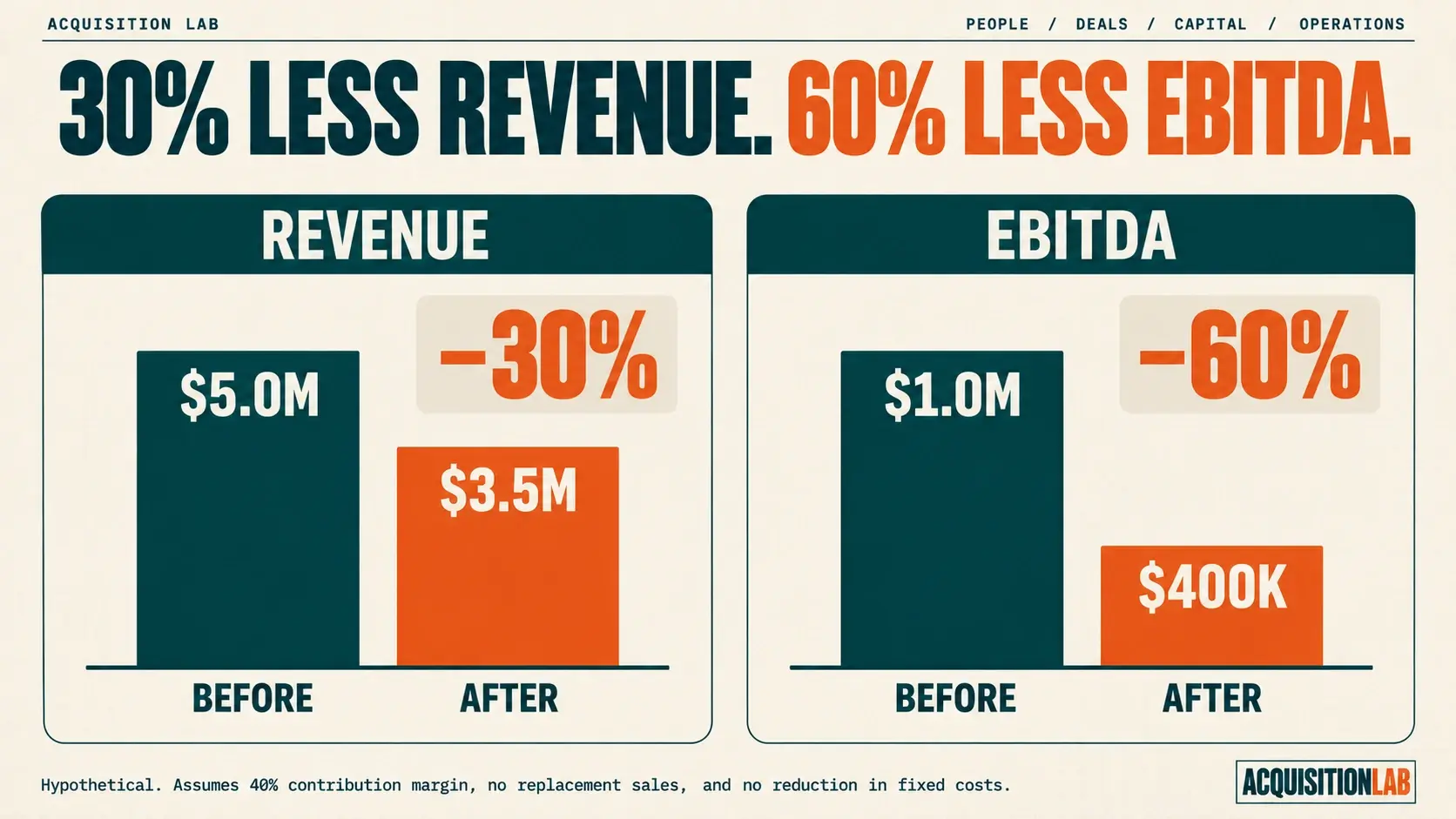
This is a simplified hypothetical, not a forecast. It assumes the lost sales carry a 40% contribution margin, with no replacement revenue or reduction in fixed operating expenses. However, the point remains: even a modest decline in revenue can cause a larger decline in earnings.
On top of that, imagine you just acquired that business using debt. Your loan payments don't automatically shrink because a major customer leaves. If operating earnings fall, you’ll have less cash available to service that debt.
That's why I don't want buyers stopping at, "Our largest customer only represents 12% of revenue." I want them asking what happens to earnings if the relationships behind those numbers change.
You can calculate concentration to see where the exposure is, but modeling the impact on earnings shows what that exposure could actually cost.
The Customer List Is Only the Beginning of Due Diligence
Once you recognize the possibility of hidden concentration, you don’t have to automatically reject the deal. As we covered in our Next Decision Framework, diligence should test the assumptions supporting an acquisition, not simply confirm the information the seller has already presented.
For customer concentration, I'd focus on three areas.
1. Find Out Where the Revenue Really Comes From
Start with customer-level revenue data covering at least three years, where available.
Look at the largest customers, but don't stop there. Several smaller accounts may belong to the same corporate group and collectively represent a significant share of revenue.
I'd want to know whether those accounts have grown, declined, or remained relatively stable. I'd also want to understand whether any unusual projects or one-time orders are distorting the numbers, and reconcile the customer-level data to the company's financial statements.
A customer generating 12% of revenue today may have represented 20% two years ago. That's a different story from a relationship that's consistently contributed 12% for a decade.
2. Figure Out Who Controls the Relationships
Once you've identified the material customers, investigate the relationships behind them.
- Who owns the companies?
- Who signs the contracts?
- Who negotiates pricing?
- Who decides whether a supplier stays on the approved vendor list?
A customer might appear independent in the accounting system while operating under purchasing policies established by a corporate parent. Conversely, several commonly owned subsidiaries might have genuinely independent purchasing authority.
You need to know which situation you're dealing with.
3. Understand Why the Customers Stay
A long customer relationship is a great sign, but buyers still need to understand what makes it durable, if anything:
- Does the business provide something that's difficult to replace?
- Are there technical integrations, specialized capabilities, or meaningful switching costs?
- Are there contracts with minimum purchase commitments, or can customers stop ordering with relatively little notice?
- How much of the relationship depends on the seller personally?
I've seen buyers focus heavily on the numbers while giving less attention to the relationships producing them. If the owner is the reason major customers stay, that increases the concentration risk because the business is much less transferable than you’d think.
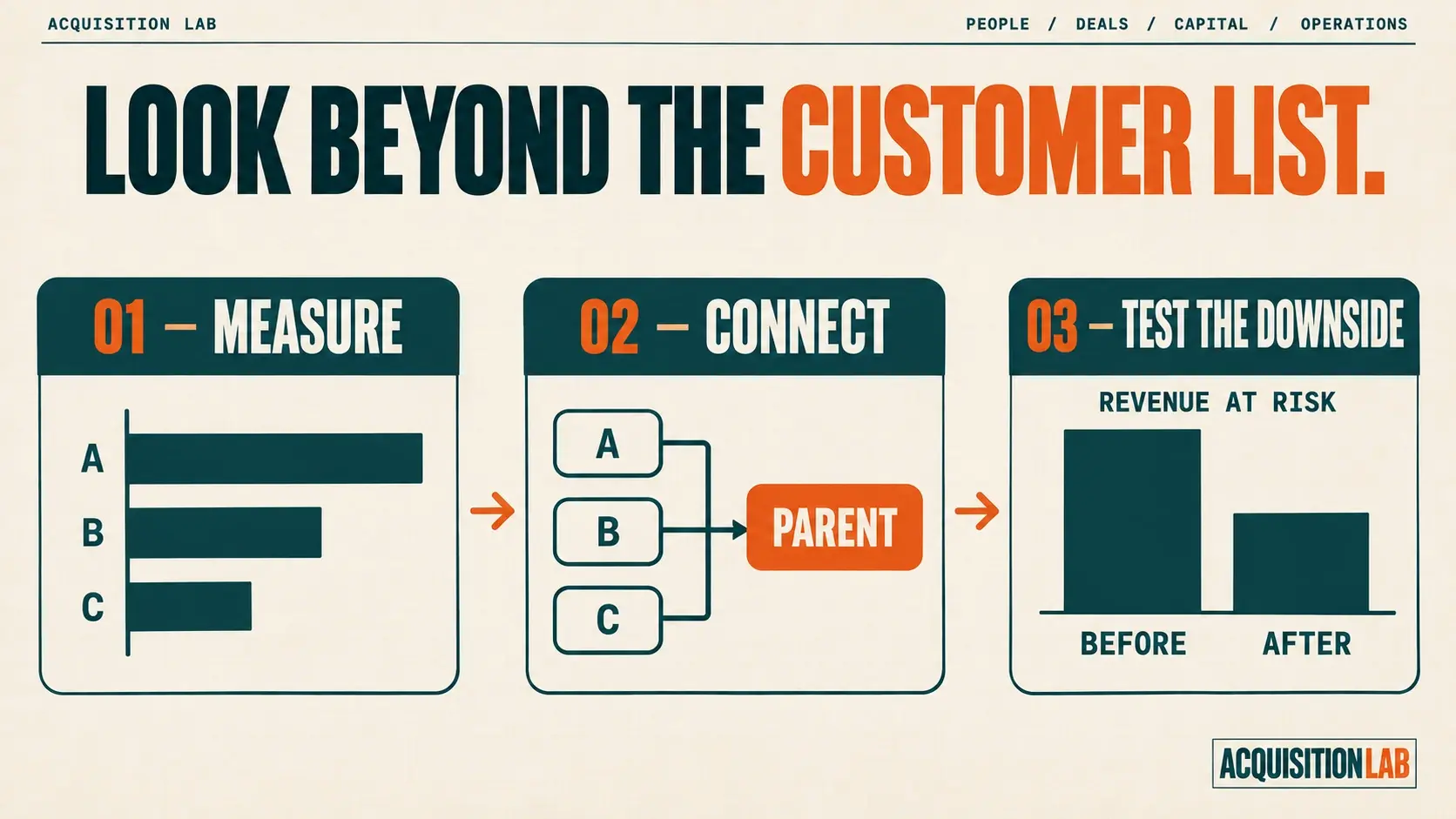
The goal isn't just to verify that customers have been buying. It's to understand why they've been buying, who can change that decision, and whether those reasons will still exist after you acquire the business.
So When Does Customer Concentration Become a Dealbreaker?
I don't think there's one magic percentage that determines whether a business is worth buying.
At Acquisition Lab, our initial screening guidelines include less than 10% of revenue from any individual customer and less than 30% from the top five. Those are helpful benchmarks to use as you’re evaluating deals, but they’re not automatic disqualifiers.
I'd be more comfortable with a business generating 25% of revenue from one customer if that relationship had strong contractual protections, meaningful switching costs, and limited signs of disruption than I would with a business whose supposedly diversified customer base was subject to one centralized purchasing decision.
The percentage matters, but the circumstances behind it matter just as much.
When evaluating risks like these, I come back to three questions:
- What's the impact? If the customer leaves, how much revenue and earnings disappear? Can the business still service its debt and meet its obligations?
- What's the probability? Is the relationship supported by long-term contracts, high switching costs, and consistent purchasing behavior? Or is the customer undergoing a merger, renegotiating supplier agreements, or preparing to consolidate vendors?
- Can the risk be mitigated? Could the buyer diversify revenue, negotiate better contractual protections, or reduce dependence on a particular customer or purchasing relationship?
That last question is important because I don't think every legitimate risk should automatically kill a deal.
As we discussed in The 3 Biggest Mistakes Buyers Make When Evaluating Deal Risk, the objective isn't to eliminate uncertainty. It's to understand what you're accepting and developing a plan to manage those risks.
For example, imagine a buyer who already has seven signed contracts with new customers that could be brought into a newly acquired business. That's a potentially meaningful mitigation strategy. The buyer isn't simply projecting future growth and hoping it materializes. There's tangible evidence of incoming customer relationships.
Of course, the value of those contracts, when the revenue will begin, and the costs of fulfilling them would all need to be evaluated before treating them as meaningful protection.
If the underlying exposure can't be reduced sufficiently, buyers can also consider retaining additional liquidity, adjusting forecasts, negotiating transaction terms that allocate some of the financial exposure, or reconsidering the price they're willing to pay. Those measures don't necessarily make a customer less likely to leave, but they can change how much financial risk the buyer accepts.
And sometimes, after evaluating the impact, probability, and mitigation options, the right decision is to walk away.
The Number of Customers Isn't the Number That Matters Most
By the time you're reviewing customer concentration during diligence, you've probably already spent considerable time evaluating the business. You've studied the financials, talked through the growth opportunities, and started imagining what ownership might look like. It's easy to treat the customer report as another box to check.
But imagine buying a business because no individual customer represented more than 12% of revenue, only to discover after closing that three of those customers answered to the same purchasing department. Or counting on a 30-year relationship that disappears after a merger. Or assuming a 30% revenue loss would mean a 30% earnings loss, when the actual impact could be twice that.
These risks don’t necessarily occur because of an accounting error or a dishonest seller. They can exist in a perfectly legitimate business with accurate financial statements.
That's why I'm emphasizing this. The danger isn't always that buyers forget to check customer concentration. It's that they check it, think they've answered the question, and stop digging.
The percentages are where the investigation starts, not where it ends.
Ready to take the next step?Join Acquisition Lab
Get the frameworks, community, and expert guidance to find, evaluate, and close your first acquisition.
Apply Now
Join us at sea · January 2027Acquire It Summit 2027
Several days of focused programming, real deal breakdowns, and relationship-building with the ETA community aboard Virgin Voyages' Brilliant Lady. Sailing from Miami to Key West and Bimini.
Reserve Your Cabin