The first payroll after your acquisition goes out on time, and nobody thanks you.
Your vendors receive their payments, and nobody calls to check on them.
Customers place orders, their payments go through, and they go about their day without giving a second thought to the fact that the business has a new owner.
Meanwhile, you've just completed one of the biggest transactions of your life.
That's exactly what I want closing week to look like.
As General Manager of Acquisition Lab Services, I help acquisition entrepreneurs prepare for the financial and operational responsibilities of owning a business. And one thing I emphasize is that getting a deal ready to close and getting a business ready to operate are two different things.
You can spend months evaluating deal risk, negotiating the purchase price, securing financing, and completing due diligence, only to discover that you aren't prepared to make your first payroll or pay your vendors.
The goal is to make the operational transition as uneventful as possible. And that takes preparation well before closing day.
Here's the 60-day timeline I recommend.
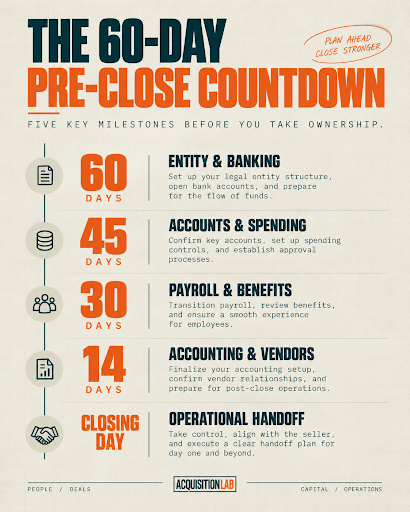
These aren't hard deadlines, and the requirements will vary depending on the business and how you're acquiring it. Think of them as milestones to work backward from as closing approaches.
60 Days Before Closing: Establish Your Legal and Banking Foundation
At roughly 60 days out, you should have your acquisition entity formed, your Employer Identification Number (EIN) in hand if required, and your banking options under consideration.
Establish Your Acquisition Entity
How you acquire the business will affect which systems you need to establish from scratch and which you may be able to retain.
Asset Purchase vs. Stock Purchase
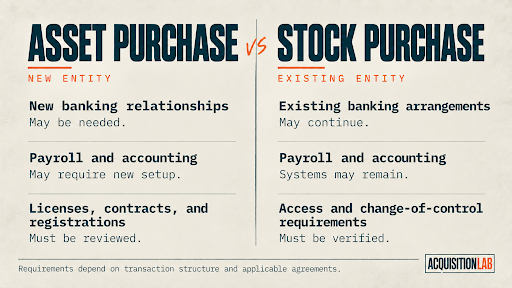
What this means for your transition: Work with the seller and your advisors to confirm which systems and relationships need to be established, transferred, or updated before closing.
The IRS provides guidance on when businesses need a new EIN, including how requirements vary depending on the entity structure.
Choose Your Banking Partner
For buyers establishing a new entity, I recommend starting conversations with banks as early as possible. Your acquisition lender may require or recommend a particular bank, but you should still understand what that banking relationship looks like.
I encourage buyers to think of their bank as more than a checking account. A good banking partner can become an important resource when you're navigating financing needs or unexpected challenges.
Your priorities at 60 days:
- Form your acquisition entity and obtain any required tax identification numbers.
- Identify the banking relationships you'll need.
- Confirm whether your acquisition lender has specific banking requirements.
- Review sales tax nexus and other state and local tax obligations with your tax advisor.
- Begin reviewing licenses, permits, and insurance requirements that may be affected by the ownership change.
That last point is worth addressing early. Depending on your industry and location, certain licenses may require new applications rather than a simple transfer. You also want to understand what insurance coverage must be effective when you assume ownership.
The SBA's business launch guidance covers the licensing, registration, banking, and insurance requirements worth reviewing with your advisors.
45 Days Before Closing: Open Accounts and Establish Spending Controls
By approximately 45 days before closing, I want to see your business bank account open and your spending card applications underway.
Opening an account for a brand-new entity can sometimes take two or three weeks. In fact, you could reasonably begin this process at the 60-day mark to give yourself more breathing room.
You also need a dedicated way to handle business expenses.
One mistake I encounter when working with existing businesses is owners using personal accounts or cards to cover business expenses. It creates unnecessary accounting work, makes expenses harder to track, and can complicate tax reporting.
Modern spending platforms make it much easier to establish controls, collect receipts, and understand where money is going.
At Acquisition Lab Services, we often use Ramp for expense management, but the underlying principle matters more than the particular software: business and personal spending should be separate from day one.
You should also understand how customers will pay the business after closing and whether any vendor payment arrangements need to change.
Your priorities at 45 days:
- Open and prepare your business bank accounts.
- Apply for dedicated business spending cards.
- Establish appropriate spending controls and expense tracking.
- Confirm how customer payments will be collected after closing.
- Identify vendors that will require updated payment information or new accounts.
The goal is to make sure the ownership transition doesn't interrupt the transactions that keep the business running.
30 Days Before Closing: Get Payroll Ready
If there's one thing I don't want a new owner to get wrong, it's payroll.
Missing your first payroll can damage employee confidence at exactly the moment you're trying to establish trust.
And the consequences go beyond employee morale. You may have a business with a substantial acquisition loan, potentially backed by your personal guarantee, and an operational disruption in your very first week.
Fortunately, payroll setup is manageable when you start early enough.
Obtain the Employee Census
At approximately 30 days before closing, you should be collecting the employee census from the seller.
An employee census is essentially a blueprint of the existing workforce. It identifies employees, their roles, compensation, and pay schedules.
You'll need to know who is salaried, who is hourly, whether employees receive commissions, and how hours are tracked.
That information is essential when you're establishing a new payroll system. Hourly and commission-based compensation can require additional preparation because you need accurate information before payroll can be submitted.
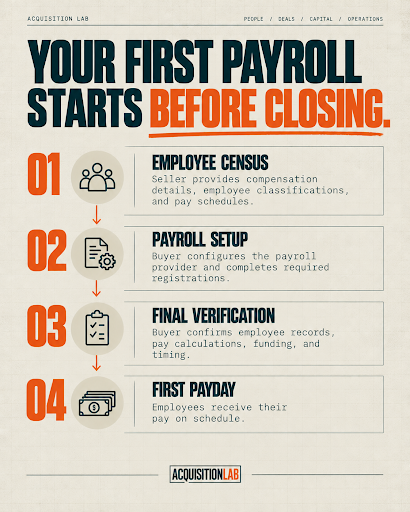
One potential obstacle is obtaining employee information from the seller, as sometimes sellers can be slow to provide the employee census. I recommend framing the request around continuity and taking care of the team they've built. Most sellers care deeply about their employees, and making sure everyone gets paid on time is a shared interest.
Set Up Your Payroll Provider
I recommend working with a dedicated payroll provider rather than trying to manage payroll compliance yourself.
We often use Gusto because it's designed for small businesses and can help with payroll administration and state registration requirements. But whatever platform you choose, it needs to be ready before employees are expecting their first paycheck.
Review Employee Benefits and Retirement Plans
Employee benefits deserve attention here, too.
If the business offers health insurance, retirement plans, or other benefits, you need to understand the existing arrangements and whether they can continue after closing.
The Department of Labor's COBRA guidance for employers is one resource for understanding potential health coverage continuation obligations. The requirements depend on the circumstances of the transaction and the plans involved.
I generally prefer to avoid unnecessary changes to employees' experience during the transition. If you can preserve existing relationships and coverage arrangements, subject to the applicable requirements, that may be preferable to introducing a completely new system on day one.
Your priorities at 30 days:
- Obtain the employee census and verify compensation arrangements.
- Establish or confirm your payroll provider.
- Understand how employee hours and commissions are recorded.
- Review employee benefits and retirement plans.
- Coordinate any necessary transitions with existing providers.
Your employees shouldn't have to worry about whether they'll get paid because the business changed hands.
14 Days Before Closing: Finalize Accounting and Vendor Arrangements
Two weeks before closing, your attention should shift to the financial records and operating relationships you'll depend on from day one.
Prepare Your Accounting Records
I recommend having your chart of accounts structured before transactions start hitting the books.
Your chart of accounts determines how revenue, cost of goods sold, expenses, assets, and liabilities are categorized.
It's the foundation for your financial reporting. If it isn't structured properly, you can end up spending months cleaning up transactions instead of using that information to run the business.
You also need to prepare your opening balance sheet.
In an asset acquisition, you're establishing the starting financial position of your new entity. You need to know which assets and liabilities are being recorded and how the acquisition is reflected in your books.
In a stock acquisition, you'll generally inherit the existing balance sheet. That doesn't mean you should assume it's accurate. You need to understand it and identify anything that requires cleanup.
Verify Essential Vendor Relationships
I also want buyers to have their vendor list finalized by this point.
Know which suppliers, service providers, and subscriptions are essential to operations. Confirm that the necessary arrangements will remain in place or that replacements are ready.
Your priorities at 14 days:
- Finalize your chart of accounts.
- Prepare or review your opening balance sheet.
- Confirm essential vendor relationships and payment arrangements.
- Verify access to critical financial and operating systems.
- Review your first payroll and upcoming payment obligations.
By this stage, you shouldn't still be discovering which systems the business depends on. You should be confirming that everything is ready.
Closing Day: Make Sure You Can Actually Operate
When closing week arrives, I want it to be boring.
And I mean that in the best possible way.
Your business bank account should be funded. Your first payroll should be scheduled or ready to schedule. Your vendors should know they're dealing with you and, where applicable, your new entity.
You should have access to the systems necessary to manage the company's finances and keep operations moving.
I recommend walking through the first week of ownership before you sign:
- Can you pay employees on schedule?
- Can customers pay the business?
- Can you pay essential vendors?
- Are the necessary insurance policies and operating permissions in place?
- Can you access the financial information you need to manage the company?
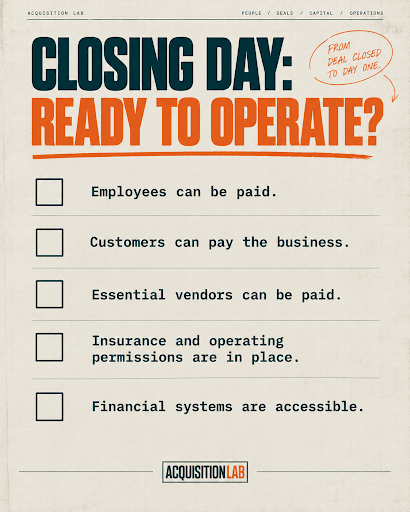
If you can't confidently check every box, you have something to resolve before taking ownership.
Don't Assume the Seller Got Everything Right
I've seen what can happen when buyers assume the seller's existing processes are correct.
One buyer I knew acquired a business that collected sales tax in its home state and the two other states generating the most revenue. After closing, the buyer continued that practice without conducting an independent sales tax nexus review.
As the business grew, other operational priorities took precedence. A year later, the company discovered that its participation in out-of-state events had created physical nexus in additional states, meaning it should have been collecting and remitting sales tax there as well.
The company was now responsible for sales tax it hadn't collected from customers.
Making matters worse, its contracts and invoices bundled taxable products with services that would otherwise have been non-taxable, such as labor. That increased the amount subject to tax and made the liability larger than it needed to be.
Two relatively straightforward reviews could have prevented the problem: a sales tax nexus analysis before closing and an examination of how contracts and invoices distinguished taxable products from non-taxable services.
The lesson extends well beyond sales tax. Just because a seller has been doing something a certain way doesn't mean it's the right way to continue doing it.
What If the Deal Falls Apart?
There's an obvious question that comes up whenever I recommend starting this work 60 days before closing:
What happens if the acquisition doesn't go through?
The reality is that deals fall apart. You might spend time establishing a banking relationship, setting up payroll, or preparing accounting systems for a transaction that never closes.
That's unfortunate, but it's part of the acquisition process.
I'd much rather see a buyer prepared for a closing that doesn't happen than unprepared for one that does.
And not all of that work is necessarily wasted.
If you continue your search, your acquisition entity, banking relationships, and some of your financial infrastructure may still be useful for the next transaction.
Of course, you'll want to coordinate the timing of major commitments with your advisors and avoid making unnecessary or irreversible changes before ownership transfers.
But the possibility of a delayed or unsuccessful transaction isn't a good reason to leave essential operational preparations until the last minute.
The Goal Is a Boring Closing Week
Most acquisition entrepreneurs are understandably focused on getting the deal done.
You're negotiating with the seller, working with lenders, coordinating advisors, and trying to get everything across the finish line.
But once the transaction closes, your responsibilities change immediately.
You have employees depending on you, customers expecting continuity, vendors that need to be paid, and a business that needs to generate enough cash to support its operations and acquisition debt.
The financial infrastructure you establish before closing is what allows you to manage those responsibilities from the beginning.
It's one thing to recognize a business worth pursuing, but it's another to be prepared for the responsibilities that come with owning it.
This process isn't glamorous, but overlooking it can create problems that consume your attention when you should be focused on learning the business, building relationships, and establishing yourself as its new owner.
My advice is to start earlier than you think you need to.
If you've done the work properly, closing week should be uneventful. And that's exactly what you want.
Ready to take the next step?Join Acquisition Lab
Get the frameworks, community, and expert guidance to find, evaluate, and close your first acquisition.
Apply Now
Join us at sea · January 2027Acquire It Summit 2027
Several days of focused programming, real deal breakdowns, and relationship-building with the ETA community aboard Virgin Voyages' Brilliant Lady. Sailing from Miami to Key West and Bimini.
Reserve Your Cabin