01
The decision
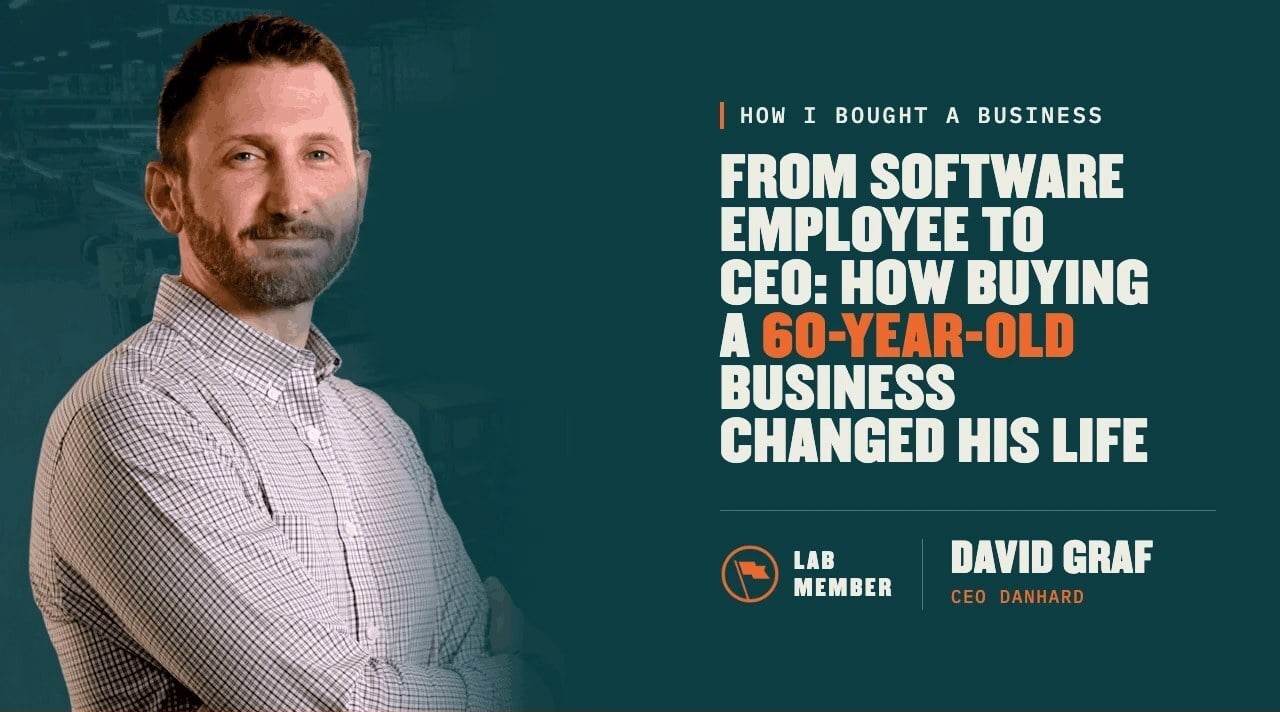
David’s mom ran a small home-based business making rubber stamps. “When I was 12, I started working in the hot garage and really developed a love for working and earning, which eventually I think did sprout into that desire for ownership.”
Years later he was working for a software company when a friend mentioned, over lunch, someone he knew who had bought a business. “That really captured my interest,” David says. “I immediately started looking into how do people do this?” He and his wife talked it over, she was on board, and they started looking for a business to buy.
Buying made more sense to him than starting from nothing. “The odds of success maybe starting a business would be 10% to 90% failure, the odds of buying a business I think were probably flipped.”
“It just made so much more sense of stepping into someone else’s shoes and that turned out to be the route that I pursued and I’m so glad that I did.”David Graf
02
The Lab
He first heard about the Lab from an advertisement on Acquiring Minds, a podcast in the space. He had two fears going in. The first was “the odds that it would fail despite my best efforts of diligencing the company.” The second was “buying something and then finding out I actually hate doing what I’m doing.”
“Part of the reason why I joined the Lab was to reduce the risk of those things happening.” He wanted to learn the work himself, “not have someone who holds your hand so firmly that they do it all for you.”
What helped most was learning how to evaluate a business. “How do I work this thing from A to Z to evaluate whether this is a good business?” he says. “I don’t think I would have been as good at that if I’d self-taught myself.”
“Going it alone means you’re Googling every question, you’re scrounging up a loose network of people that might be willing to spend some time with you.”David Graf
03
The bell curve
Danhard was not the obvious choice. “It was smaller than other companies I had put offers on previously, much smaller, but there were some things about it kind of told me to keep pursuing.” The company was founded in 1963 in Dallas, and the founder, now 96, was selling. David has “tremendous respect for a man that just dedicated his life to building a terrific company.”
Manufacturing was not where he had spent most of his career, but he could see that the skills Danhard needed were complementary to his own. It wasn’t until, in his words, “my wife and I drove away from seeing the business here in person, and we looked at each other and we said, ‘This could be the one.’”
Then he drew the bell curve for her. “Look, if we buy it and it goes about average, here’s what that looks like for our life. If it goes really well, here’s what that could look like. And if it goes poorly, that could end in personal bankruptcy, but here’s what that would look like.” She saw what he saw. “Okay, let’s do it.”
“I wasn’t going to do this without the two of us being fully united in the pursuit.”David Graf
04
Day one
A transition means customers, vendors and employees, and David knew which mattered most. “Employees was obviously the most critical one to nail. And so, we started day one with the announcement.” Given the seller’s age, he doesn’t think there was much surprise, and “probably some relief in the fact that this business will live on under new ownership.”
There were some tears. The team had decades-long relationships with the founder. David explained who he was and what he planned, and “announced things like better PTO, a 401k, better health benefits. And I’m happy to say that we’ve done every single thing that was on that list.”
The team noticed. “You sit in meetings, you talk, you talk, you talk, and nothing ever happens,” one of them says. “Well, it happens here.”
The work now is under the surface. “We are rebuilding the foundation of the building underneath us, so that when I put my foot down on the accelerator for sales and marketing, we’re not going to crumble.”
“I’m so eternally grateful that everyone gave me a chance to see if I was worth staying on for.”David Graf