When you own an asset, you have a claim on any value that it produces, such as through direct cash flow or an eventual sale. That asset may also appreciate over time while debt repayment can steadily increase the portion of its value that belongs to you.
That’s different from something like income, where compensation is earned in exchange for time, labor, or expertise. However, that doesn’t mean income is a bad thing.
If you’re like many aspiring entrepreneurs, income is critical to your long-term success. A strong salary provides the security and capital you need to save, invest, and prepare for ownership. But the sum of your work and expertise will always benefit an asset owned by someone else — unless you are the owner.
Business ownership fundamentally changes the relationship between work, income, and wealth. All paths to ownership carry some level of risk and uncertainty, but the right approach can offset many of those challenges before capital is committed.
In this guide, you’ll learn:
- How ownership builds wealth differently from earned income
- How the Four Levers of Return generate wealth through ownership
- How business assets allow wealth to compound over time
- How the risks of ownership can affect wealth creation
What It Takes To Buy A Business
Before any of the levers below start working for you, there’s a floor you have to clear. Buying a business isn’t something you back into with no preparation, and it isn’t reserved for people with millions in the bank. Here’s what it actually takes:
- Cash for a down payment and transaction costs. Debt-backed deals typically require 10-30 percent down (U.S. buyers can get it down to 10% with an SBA loan), plus closing costs and legal fees on top of that.
- Liquidity beyond the down payment. You need a cushion for day-to-day operations and the unexpected expenses that show up in the first year of owning anything.
- A multi-year commitment. These levers realize value over years, not months. If you’re looking for something you can turn around quickly, this isn’t the vehicle.
- Real experience or a credible plan. Lenders and sellers both want to see that you can actually run what you’re buying, not just that you can afford it.
- Financing, and usually a personal guarantee. Unless you’re paying cash, SBA-backed acquisitions require you to personally guarantee the loan.
None of this is meant to scare you off. It’s meant to be honest about the floor, so the rest of this piece makes sense in context.
How Ownership Turns Work Into Wealth
Compensation and ownership solve two different problems, and it’s easy to blur them together because both eventually show up as a number in a bank account.
Compensation pays you for the value you create, in the moment you create it. When you stop working, the payments stop. The value you created is still there, but you don’t have a claim on it anymore. It belongs to whoever owns the thing you built it inside of.
Ownership doesn’t pay you for the work itself. It gives you a claim on whatever the work produces, for as long as you hold that claim.
That distinction is the entire reason the two paths end up in such different places over time.
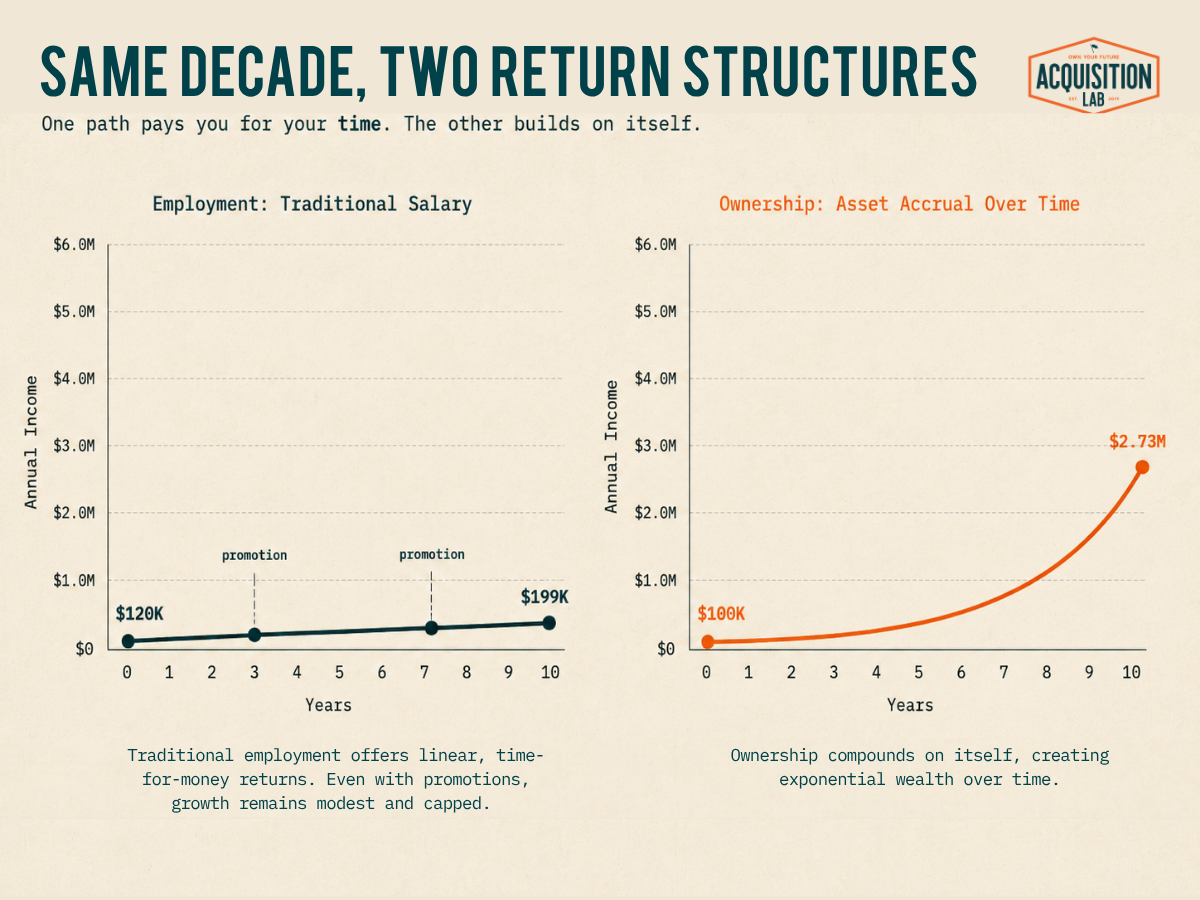
When people ask me how much they should pay themselves after buying a business, they’re usually comparing that number to a salary, but that’s the wrong comparison to make. A salary is compensation for your time, and it can only move as fast as raises and promotions allow.
The Four Levers of Return
Ownership is a different mechanism entirely. It produces returns through four separate channels running at the same time: equity, cash flow, debt paydown, and exit. A salary is one line of compensation, and it moves only as fast as raises and promotions allow.
These four channels compound together instead, which is exactly what the chart above shows: one path moves in a straight line, the other bends upward. It isn’t that one path works harder than the other. It’s that one path only has a single lever to pull, and the other has four.
Equity Ownership
When you own equity, you own a piece of the business itself, net of whatever debt is still owed against it. Equity turns ownership into wealth, and it’s what the other three levers depend on too: cash flow needs a claim to flow into, debt paydown needs an asset underneath it, and an exit needs a claim to sell.
Example: Assume you buy a $1 million business with $100,000 down and $900,000 in financing. You don’t just own the portion of the business that’s worth $100,000. You own the entire $1 million asset, from the moment you close. Your equity, what’s actually yours net of debt, starts at $100,000. But you control, and have a claim on, the full $1 million from day one. That distinction is what makes debt paydown its own lever rather than just part of equity.
Income only becomes wealth once it’s saved and converted into something that holds value, but when spent, it leaves nothing behind. Stock options and restricted stock units (RSUs) have made “employees can own equity too” a common talking point, but the reality is narrower than that framing suggests:
- Unvested: shares disappear if you leave before they vest.
- Options: require you to pay to exercise them before you own anything at all.
- Illiquid: unless the company is publicly traded, there’s no market to sell into, and you don’t control when they sell the company.
What you’re holding is compensation shaped like ownership, but not ownership itself.
Actual business ownership doesn’t have that problem. It’s a direct claim on an asset, and the facts back that up. Federal Reserve data shows families that own a business have higher income and wealth than families that don’t, and that gap widens with the size of the business.
Ownership carries real risk, with most of it concentrated in a single asset rather than spread across a portfolio and with no public market pricing it day to day. It’s a fundamentally different position when compared to employment, because you own an asset and aren’t being paid directly for the time you work on it.
Cash Flow During Ownership
Any business you own generates income while you hold it, separate from whatever you get at sale. That cash flow is measured in seller discretionary earnings, or SDE: a business’s total cash flow before subtracting a salary for whoever runs it day to day.
Building on the example above: Assume your $1 million business generates $334,000 a year in SDE, the business’s total cash flow before subtracting a salary for whoever runs it day to day.
Unlike a private equity fund that asks investors to wait four to seven years for a single payout, an owner-operated business can pay you the entire time you hold it.
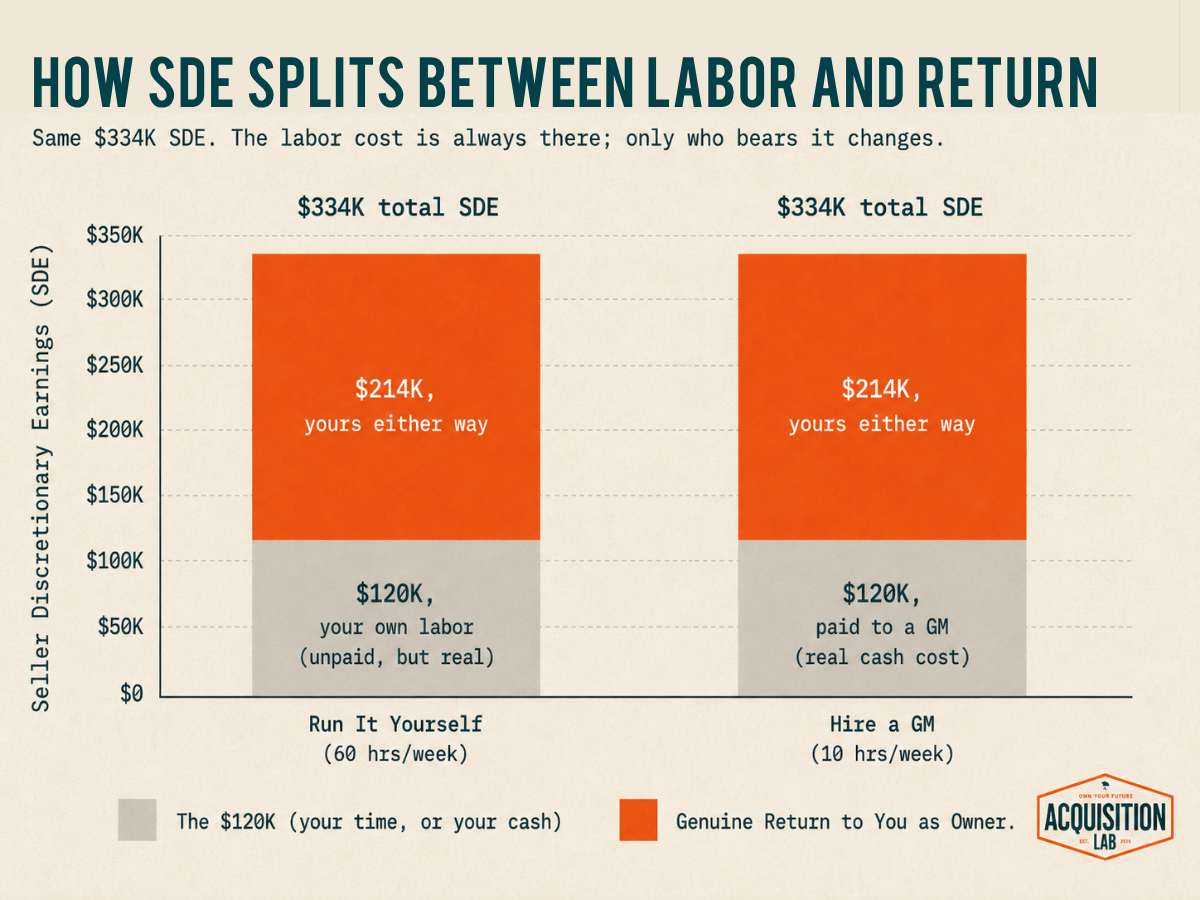
Using the business from our working example, some of that $334,000 is a genuine return on your equity. Another portion is actually a market-rate salary for the work of running the business — the amount you’d have to pay a general manager to do your job if you weren’t doing it yourself. SDE blends both into one number, which is why two businesses can report identical SDE while having very different actual returns and amounts of time spent in the business.
Here’s how that $334,000 from our example business breaks down:
An employee doesn’t have this option. A salary is fixed pay for time worked. There’s no pool of company cash flow an employee gets to direct, no matter how well the company performs.
This lever also competes with itself. Debt service and reinvestment both want a piece of that cash flow, and in the first year or two of ownership, there may not be much left over at all. That competition isn’t a flaw, though. It’s a sign the cash flow is doing double duty. Every dollar that goes toward debt service isn’t lost – it’s working as its own lever entirely.
Debt Paydown
Most acquisitions aren’t fully paid for in cash. A buyer typically puts down a fraction of the purchase price, often 10 percent, and borrows the rest, commonly through a bank loan (typically an SBA loan for U.S.-based buyers). That loan is a real debt, owed to a real lender, and it has to be paid back over time just like a mortgage does.
Here’s the part that makes this lever different from anything a paycheck can do: the business itself makes those payments, not you personally. You already control the entire asset from the day you close, but your net equity in it, what you’d actually keep if you sold, starts out small and grows every month the loan balance shrinks.
This automatic shift from debt to equity has a name: forced equity. It’s equity you didn’t have to save up for or write a check for, created as a side effect of the business simply operating and paying down what it owes. It shows up on your personal balance sheet, the running tally of what you own minus what you owe, as real, growing net worth, even if you never touched a dollar of it yourself.
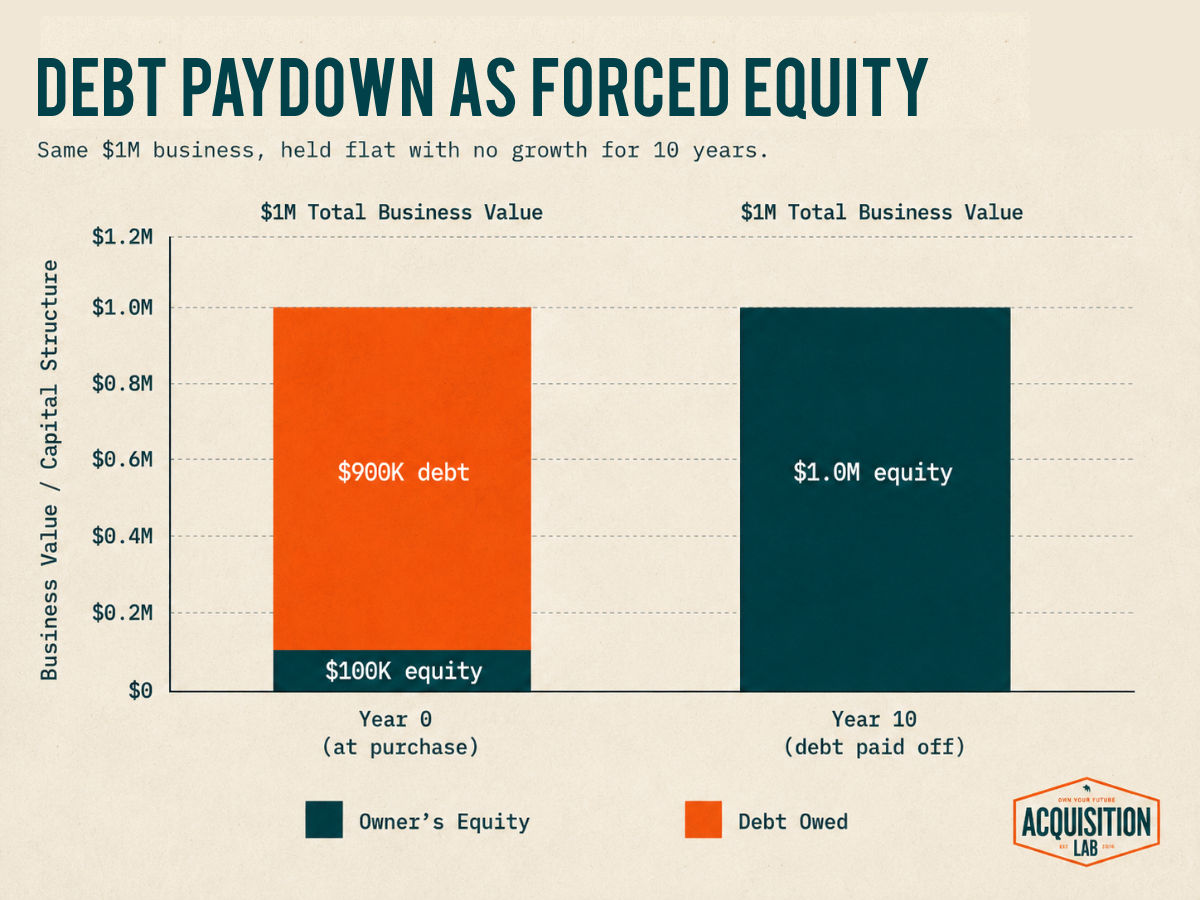
Example: Go back to the $1 million business from our running example, purchased with $100,000 down and $900,000 in debt. Let’s assume that everything stays the same for ten years. The business doesn’t grow or shrink. It remains completely steady. That $900,000 loan is on a 10-year term, so by year ten, it’s fully paid off. As the owner, you now keep the cash flow that used to go to your lender, and you own the $1 million asset outright. Grow the business even modestly during that decade and the effect compounds even further.
An employee has nothing like this. There’s no version of a job where simply showing up causes an asset to build on your personal balance sheet.
There’s a real caveat here, though: Taking on more debt than the business can comfortably service is one of the most common ways searchers get themselves into trouble. Debt paydown works because the business earns its way through the debt, not because debt itself is good.
Exit Or Transfer Value
The exit is the event where a business gets sold and a multiple, the price stated as some number times its annual earnings, gets applied to determine what it sells for. This is the lever that converts years of equity, cash flow, and debt paydown into a single event, and it’s the closest thing this model has to cashing out a career all at once.
Building on our original example: Say you bought that $1 million business at a 3x multiple on $334,000 in SDE. If you sold it years later at that same 3x multiple with no growth at all, it would still be worth $1 million, but debt paydown will have already converted much of that value into equity you keep rather than owe.
Grow the business even modestly during the hold, and the multiple applies to a larger number, so the exit is worth more than the business you originally bought. At a 3x multiple, every dollar you add to the business’s annual earnings becomes three dollars in your pocket at sale. This isn’t because the deal terms changed, but because what you’re selling has changed.
An employee doesn’t get this moment. Years of raises and tenure never convert into a lump sum. The paycheck just stops when the job does.
Debt paydown and even modest growth both increase the number you realize at exit, which is why the exit tends to be the largest single event in the whole return.
How Ownership Compounds Value Over Time
There’s a real difference between money that adds up and money that compounds, and it’s worth being precise about which one you’re actually building toward.
Income adds. A paycheck arrives, you deposit it, and your account balance goes up by exactly that much. The next paycheck adds more , on top of what was already there. Nothing about this week’s paycheck changes what last week’s paycheck is worth.
Wealth compounds. Every month a business operates, it’s doing several things at once: paying down debt, throwing off cash flow, and (ideally) growing. Each of those mechanisms doesn’t just add to the pile; they fundamentally change what the next month’s activity is worth. Less debt means more of next month’s cash flow is yours to keep. A larger business means the next dollar of growth is worth more at exit than the last one was.
Why Compounding Takes Time
This is also why none of this shows up quickly. There’s a real difference between addition and compounding: addition happens immediately, compounding takes time. In year one, debt paydown is small, cash flow is thin, and growth on a small base doesn’t move the needle much in absolute terms. This is also why new owners are often surprised to find they’re taking home less, month over month, than they were at the high-paying job they left. The four levers are all real from day one, but their interaction needs a base to work on, and that base only builds gradually.
That doesn’t mean nothing is happening. In the background, debt is quietly being paid down every month. Cash flow grows as the business grows. Equity is building on the balance sheet whether or not you’re watching it closely. None of these show up as a dramatic number yet, but they’re compounding on each other the entire time.
Over years, not months, those levers start working together instead of separately, and the value they create eclipses what a salary could ever produce. It’s the same reason a retirement account looks unimpressive in its early years and dramatic in its later ones: the mechanism doesn’t change, but the size of what it’s acting on does, and that size only shows up after a decade or two of compounding, not a year or two.
How the Four Levers compound
Each lever adds value on its own. The reason ownership outperforms a salary isn’t any single one of them, it’s that all four are increasing the same underlying number at the same time.
- Cash flow. The cash a business generates during the hold can be reinvested rather than taken home, which grows the business faster than its own organic growth would alone. That larger business then throws off more cash the following year, which can be reinvested again.
- Debt paydown. Debt paydown increases what you own free and clear at exit. Every payment against acquisition debt converts a little more of the business from the bank’s asset into yours.
- Business growth. Growth increases earnings, and earnings are the base every other lever acts on. A larger earnings base means more cash flow, faster debt paydown in dollar terms, and a bigger number for the exit multiple to apply to.
- Exit multiple. At sale, the multiple gets applied to whatever the business has become, not what it was on day one. A business that’s grown, paid down debt, and reinvested cash flow along the way is being sold as a fundamentally larger asset than the one that was purchased, so the same multiple produces a much larger number.
None of these levers is doing anything unusual on its own. What makes ownership different is that they’re all acting on the same growing base, at the same time, for as long as you hold the business.
Ownership: A Five-Year Example
Everything above is the theory. Here’s what it looks like worked out in actual numbers, using a common, realistic scenario rather than an extreme one.
Starting Assumptions
- Purchase price: $1,000,000 (3x starting SDE)
- Starting SDE: $334,000
- Down payment: $100,000
- Financing: $900,000 SBA loan, 9.5% interest, 10-year term
- Annual growth: 5%
- Hold period: 5 years
- Exit multiple: 3x (same multiple paid at purchase)
- Owner’s annual draw: $120,000
Some points to note in this example:
Interest Rate: We’re using lending rates for when this was written, not the lower historical rates you’ll sometimes see in illustrative examples elsewhere. That makes this example conservative rather than cherry-picked, and it means the numbers below only get better for a buyer if rates come down. Every figure that follows is reproducible from the assumptions above; nothing is hidden.
Hold Period: Five years is a reasonable middle ground. This period is long enough for debt paydown and modest growth to meaningfully change the numbers but short enough to stay grounded rather than reaching for a dramatic, decade-plus scenario.
Annual Growth: Five percent annual growth is deliberately modest. It’s not a projection that requires a turnaround story or an aggressive growth plan to hit — just steady, ordinary performance.
Owner’s Draw: The $120,000 draw is the same figure used in the salary comparison earlier in this piece, so the two paths can be compared on equal footing later on.
Returns During Ownership
At purchase, this business generates roughly $334,000 a year in seller discretionary earnings (SDE).
- Year five SDE: roughly $426,000, with 5 percent annual growth.
- Owner’s draw: $120,000 a year, flat across all five years, totaling $600,000.
- Remaining cash flow: available to service debt, reinvest, or add to what you keep at sale.
That draw doesn’t grow the way a salary might through raises or promotions. It’s fixed. Every dollar of upside beyond that $120,000 a year comes from the other three levers, not from the business paying you more to run it.
Equity Through Debt Paydown
At the same time cash flow is growing, the $900,000 loan balance is shrinking.
- Loan terms: $900,000 at 9.5 percent over a 10-year term.
- Principal paid down: roughly $345,000 over the first five years.
- Remaining balance: about $554,000.
That paydown happens using the business’s own earnings, not money out of your pocket, and it converts directly into equity you own outright. Combined with the business’s growth, your equity position moves from a $100,000 down payment to roughly $726,000 by year five, the $1.28 million the business is now worth, minus the $554,000 still owed on it. That’s before the sale itself even happens.
Value at Exit
If you were to sell at year five, that larger, less-leveraged business could reasonably list for around $1.28 million, based on a 3x multiple applied to its now-larger SDE.
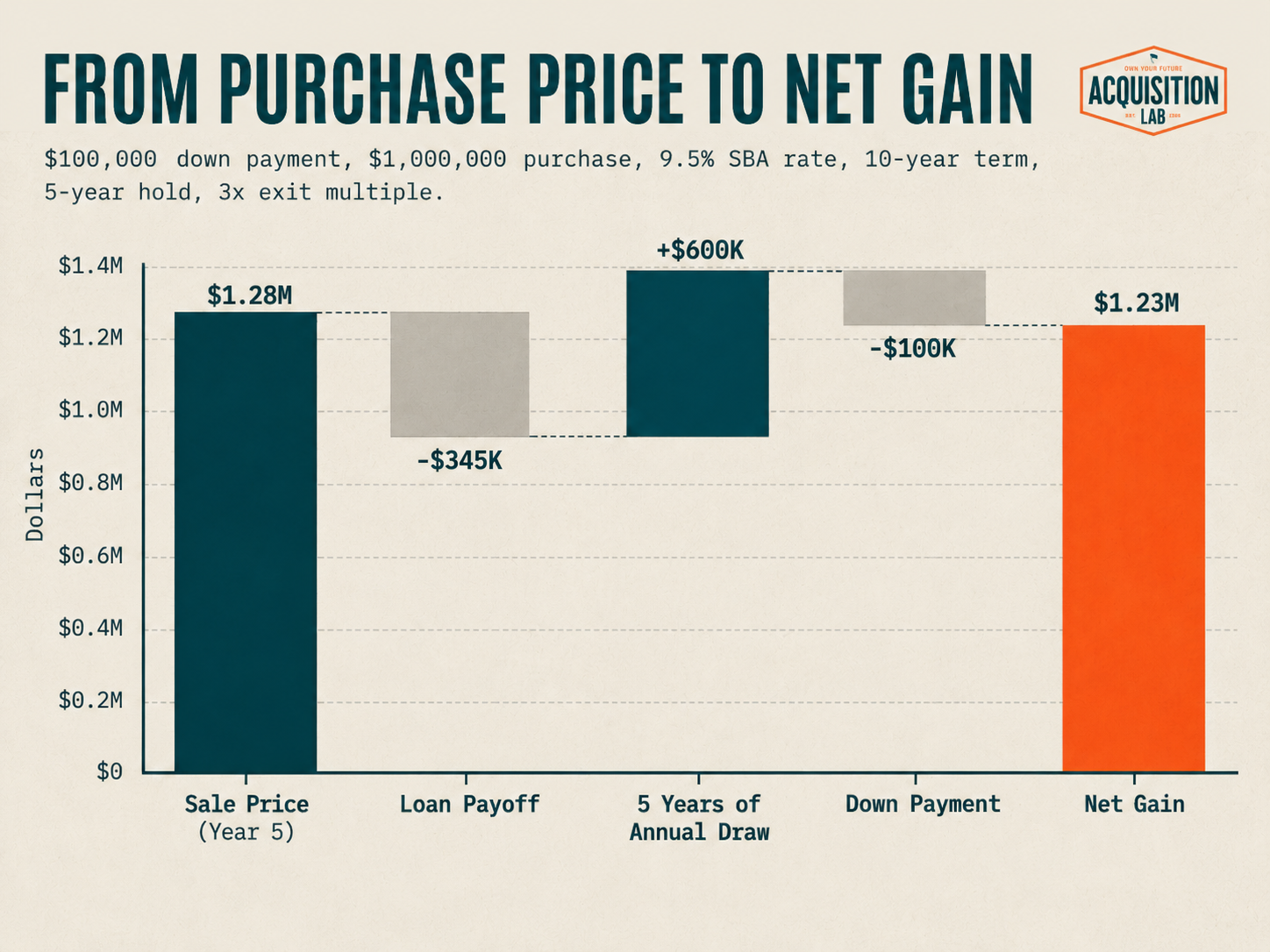
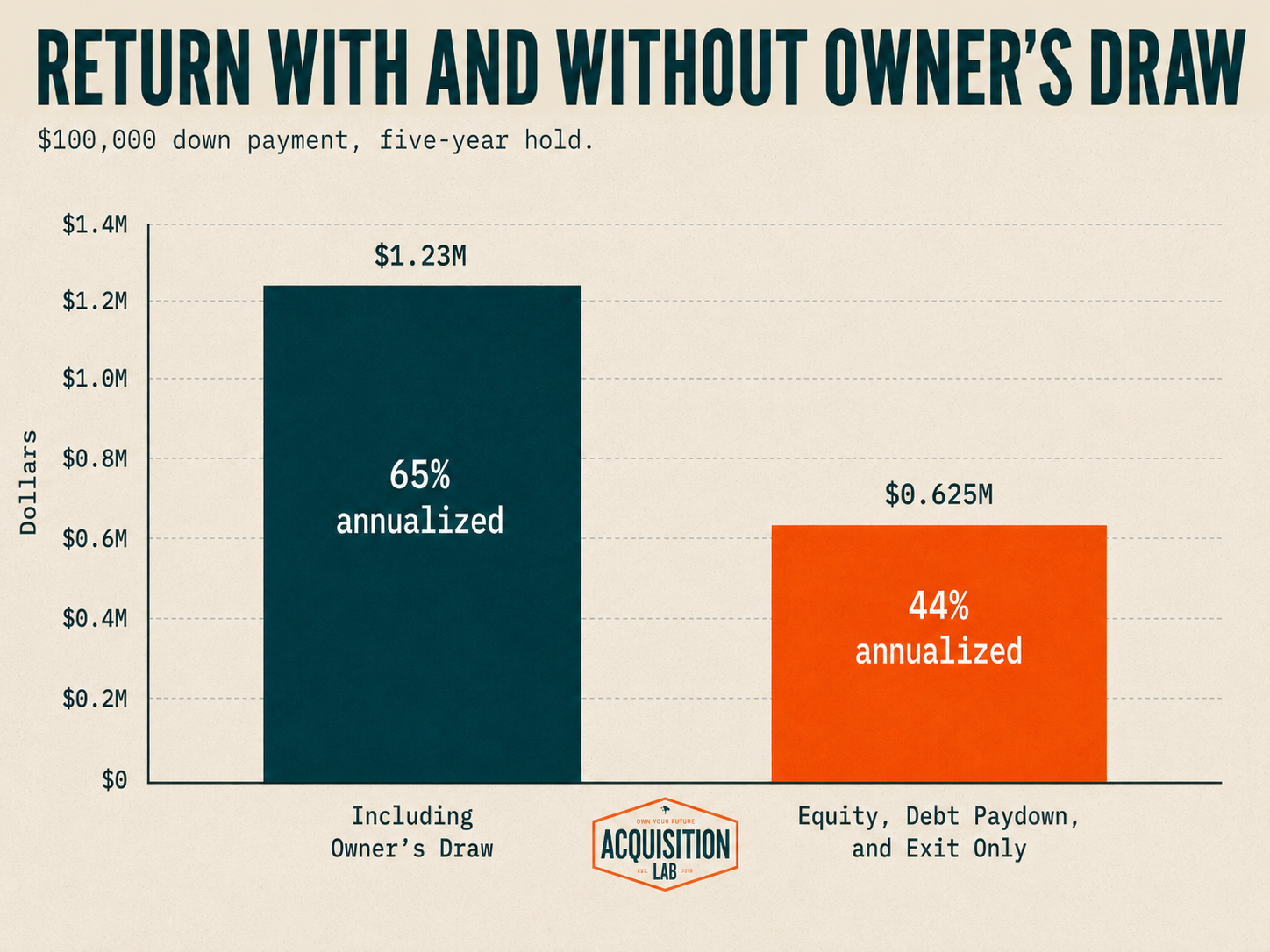
Add it up: sale price, minus the remaining loan balance, plus five years of annual draw, minus your original down payment. Your $100,000 investment has grown to roughly $1.23 million, an annualized return near 65 percent.
To be clear, this example assumes a sale at year five for the sake of showing the full math. Most owners aren’t buying with a fixed exit date in mind, but are instead building something they intend to run and grow. The eventual sale is a “someday” rather than a planned flip. The numbers below work the same way whether that day comes in year five or year fifteen.
Value Breakdown: With and Without Owner Compensation
The $1.23 million figure above includes your $600,000 in draws, money that was partly replacing a salary you’d have earned somewhere else anyway. It’s worth separating that out, since it changes what the return is actually measuring.
Strip the draw out entirely, and the same $100,000 investment still grows to about $625,000 — an annualized return near 44 percent — from equity, debt paydown, and the exit alone, with no credit given for the years of income you drew along the way.
What Can Affect Ownership Returns
Everything covered so far describes what happens when the entire ownership process works as intended. It’s worth being just as direct about what can make it not work, because every lever above depends on conditions you don’t fully control.
Business Performance
The math throughout this piece describes what happens when a business is run well, but performance is not guaranteed. If the business underperforms, every lever slows down with it. That means less cash flow to distribute, slower debt paydown, and a smaller number at exit.
Lab member David Graf bought a business with the numbers already working in his favor, and grew adjusted earnings by 58 percent in under two years, largely by tightening how the business managed its inventory and cash conversion cycle. That growth came from the operating decisions he made, not from any feature of the deal itself. The reverse is just as true: a business bought well can still underperform in the hands of an owner who runs it poorly.
How to reduce this risk:
- Buy a business with a track record long enough to judge, not just a good story.
- Have a real operating plan before you close, not just a financial model.
- Stay close enough to the numbers that underperformance shows up early, not a year later.
Purchase Price and Margin Of Safety
Every return in this calculation is based on the original purchase price. Overpay, and the same business produces a worse return on every lever at once, not just one. Optimistic assumptions about growth, margin, or how quickly a business will improve can justify almost any price on paper, which is exactly the problem: the assumptions end up doing the work of making a deal look better than it is, not the business itself.
A higher purchase price usually means more debt, too, which raises the stakes on the leverage risk below at the same time.
How to reduce this risk:
- Favor a business with a real growth trend already in place over a mature one you’re hoping to reignite.
- Complete full diligence before making an offer, not after.
- Set your own walk-away price and margin of safety before you’re emotionally invested in a specific deal.
Leverage and Personal Guarantees
Almost every path to buying a business at this stage requires you to personally guarantee the debt, whether that debt is SBA-backed or conventional.
No lender is going to loan millions of dollars against a business and let you walk away with no consequences if something goes wrong. If the business fails, that debt doesn’t stay inside the LLC. It follows you.
SBA default rates remain historically low relative to startup failure rates, but that’s a claim about the financing surviving, not about your business specifically. It says nothing about whether any individual business performs the way a model assumes it will.
How to reduce this risk:
- When taking on debt, look at what the business can comfortably service based on current performance, not projected earnings.
- Keep a real cash buffer separate from what you need to cover debt service.
- Understand exactly what you’re personally on the hook for before you sign, not after.
Concentration and Liquidity
Ownership carries real risk that’s structurally different from owning a diversified investment portfolio: most of your capital is concentrated in a single asset, and there’s no public market pricing it day to day. You can’t sell 10 percent of a business on a bad week the way you could sell shares of a stock.
This is also why the multi-year time horizon matters. These levers realize value over years, not months, and anyone expecting fast liquidity from this model is in the wrong vehicle.
How to reduce this risk:
- Don’t commit capital you might need access to on short notice.
- Go in expecting a multi-year hold, not a quick turnaround.
- Understand that your net worth will be concentrated in this one asset for a meaningful stretch of time.
Exit Uncertainty
None of this is guaranteed, though. Your anticipated sale value can move as the business grows or shrinks, as market conditions shift, or as buyer timelines slip past what you’d planned for. And a meaningful share of small businesses never sell at all, whether because no buyer materializes at the price a seller wants, the business isn’t in sellable shape when the owner is ready to exit, or the owner simply keeps running it rather than transacting.
How to reduce this risk:
- Don’t build your plan around a specific exit multiple or timeline.
- Run the business as if you’ll hold it indefinitely, so its value doesn’t depend on a sale happening on schedule.
- Treat an eventual sale as a “someday,” not a fixed date you’re managing toward.
Check for Understanding
Before moving on, you should be able to answer each of these. If you can’t, the section to revisit is noted next to it.
- What’s the real difference between income and wealth? (How Ownership Turns Work Into Wealth)
- What are the Four Levers of Return, and what does each one do? (The Four Levers of Return)
- Why do the four levers compound instead of just adding up? (How Ownership Compounds Value Over Time)
- Why does stripping out the owner’s draw change what a return is actually measuring? (Ownership: A Five-Year Example)
- What are the main categories of risk that can reduce or eliminate these returns? (What Can Affect Ownership Returns)
A few terms worth having solid before moving on:
- SDE (seller discretionary earnings): a business’s total cash flow before subtracting a salary for whoever runs it day to day.
- Hold period: the length of time you own the business before selling or transferring it.
- Multiple: the price of a business stated as some number times its annual earnings.
- Forced equity: equity created automatically as debt gets paid down, without you saving or writing a check for it.
If any of these don’t come easily, that’s a signal to go back, not a failure. The Four Levers framework discussed here is the one piece of this worth carrying with you past this article. Concepts in future guides will build on it.
Up Next
The Four Levers framework shows up again throughout this program, this article is the foundation, not the whole picture. From here, the natural next step is Buy, Build, Franchise, or Invest?, where we get into how buying an existing business compares to starting one, franchising, or investing passively, so you can figure out which path to ownership actually fits you.
If you want additional context beyond what’s covered here:
- The SBA’s own guide to 7(a) loans covers the mechanics of the financing itself, if you want more detail on how the debt piece of this actually works.
- SCORE’s guide to determining a fair owner replacement salary is useful if you want to go deeper on the SDE question raised earlier in this piece, what a business would actually cost to run without you.
FAQ
Why does ownership build wealth differently than earning a salary?
A salary pays you for your time, one line of compensation that stops the moment you stop working. Business ownership works differently: it produces returns through four channels running at once, equity in the business itself, cash flow the business generates while you hold it, debt paydown that converts loan payments into ownership automatically, and the eventual exit or sale. Because those four channels compound together rather than adding up separately, ownership can build wealth at a pace a single salary, even with regular raises and promotions, structurally cannot match.
Is owning a business better than earning a high income?
They aren’t directly comparable, since they solve different problems. A high income can fund a strong lifestyle and meaningful savings, but it’s still compensation for time worked, and the payments stop when the work does. Business ownership converts effort into a claim on an asset you hold, one that can appreciate, generate cash flow, and be sold, independent of whether you’re actively working that day. It’s a structurally different way to build wealth than income, and it comes with structurally different risks, including concentration in a single asset and the personal guarantees typically required to finance the purchase.
What’s the difference between income and wealth?
Income is a flow, money that arrives on a regular basis and, if unspent, can be saved. Wealth is a stock, a snapshot of what you own minus what you owe at a given point in time. The two are related but not the same: income only becomes wealth once it’s saved and converted into something that holds value, like equity in a business or a home. Spent, it leaves nothing behind. That’s why a high income doesn’t automatically translate into wealth, and why owning an appreciating asset can build wealth even for someone earning a comparatively modest income.
Why is equity more valuable than compensation?
Equity is a claim on an asset’s value, not payment for time worked, which means it exists independent of any single paycheck and doesn’t disappear when the work stops. In business ownership, equity is also the foundation every other wealth-building lever depends on: cash flow needs a claim to flow into, debt paydown needs an asset underneath it to build equity against, and an exit needs a claim to sell. Compensation, no matter how large, only ever pays for the moment it’s earned in.
How do business owners build generational wealth?
Business owners build generational wealth primarily through the same four levers, equity, cash flow, debt paydown, and exit, compounding over a long enough hold. Unlike income, which stops when the person earning it stops working, a business is an asset: it can be passed directly to the next generation, or sold and converted into other assets like real estate or investments. Either way, the wealth built during the hold doesn’t disappear when the original owner steps back, which is what makes ownership a viable engine for wealth that outlasts one person’s working life.
Can buying a business accelerate wealth creation?
Often, yes, relative to starting a business from scratch. Most new businesses spend their first several years simply trying to survive, working out their product, customers, and operations before they generate meaningful, stable cash flow. Buying an established business means buying past those riskiest early years, since it already has a track record, existing customers, and proven cash flow. That lets the four wealth-building levers, equity, cash flow, debt paydown, and exit, start compounding immediately instead of waiting years for a new business to find stable footing.
Does ownership always outperform employment?
No, and it’s worth being direct about that. Ownership describes a mechanism that can outperform a salary, not a guaranteed outcome. Sale multiples move with the market, timelines slip past what an owner planned for, and a meaningful share of small businesses underperform or never sell at all. The four levers, equity, cash flow, debt paydown, and exit, only compound into real wealth when a business is bought at a reasonable price and run well. Overpay, run it poorly, or hit a downturn, and the same mechanism that builds wealth can just as easily fail to.
What risks come with business ownership?
Five main categories: business performance (a business that underperforms slows every lever at once), purchase price and valuation (overpaying makes every return worse, not just one), leverage and personal guarantees (most acquisition debt is personally guaranteed, meaning that debt follows the owner if the business fails), concentration and liquidity (most of an owner’s net worth sits in one illiquid asset rather than a diversified portfolio), and exit uncertainty (sale multiples and timelines aren’t guaranteed, and some businesses never sell). None of the four wealth-building levers work independent of these risks. They all depend on a business that survives, was bought at a reasonable price, and is run well.