You can negotiate a great purchase price, secure financing, and get comfortable with the valuation of a business without answering one critical question:
How much money does this business actually need to operate? And, just as importantly, who's providing it?
Working capital refers to the short-term assets and liabilities that support a business's day-to-day operations. It’s one of those subjects that sounds straightforward until you're negotiating an acquisition. Then you discover that the buyer, seller, business broker, and lender may have four different ideas about what should be included in the purchase price.
I'm Heather Endresen, owner of Viso Business Capital and a Preferred Partner at Acquisition Lab. I've spent more than 30 years in banking, and one thing I've learned is that you can structure a deal that looks perfectly reasonable on paper and still leave the buyer in a terrible position after closing. Working capital is a particularly good example of that.
The mistakes I see aren't usually arithmetic mistakes. They're mistakes in how buyers think about what they're purchasing, how they finance it, and what they're willing to agree to before they have all the information.
A Profitable Business Can Still Run Out of Cash
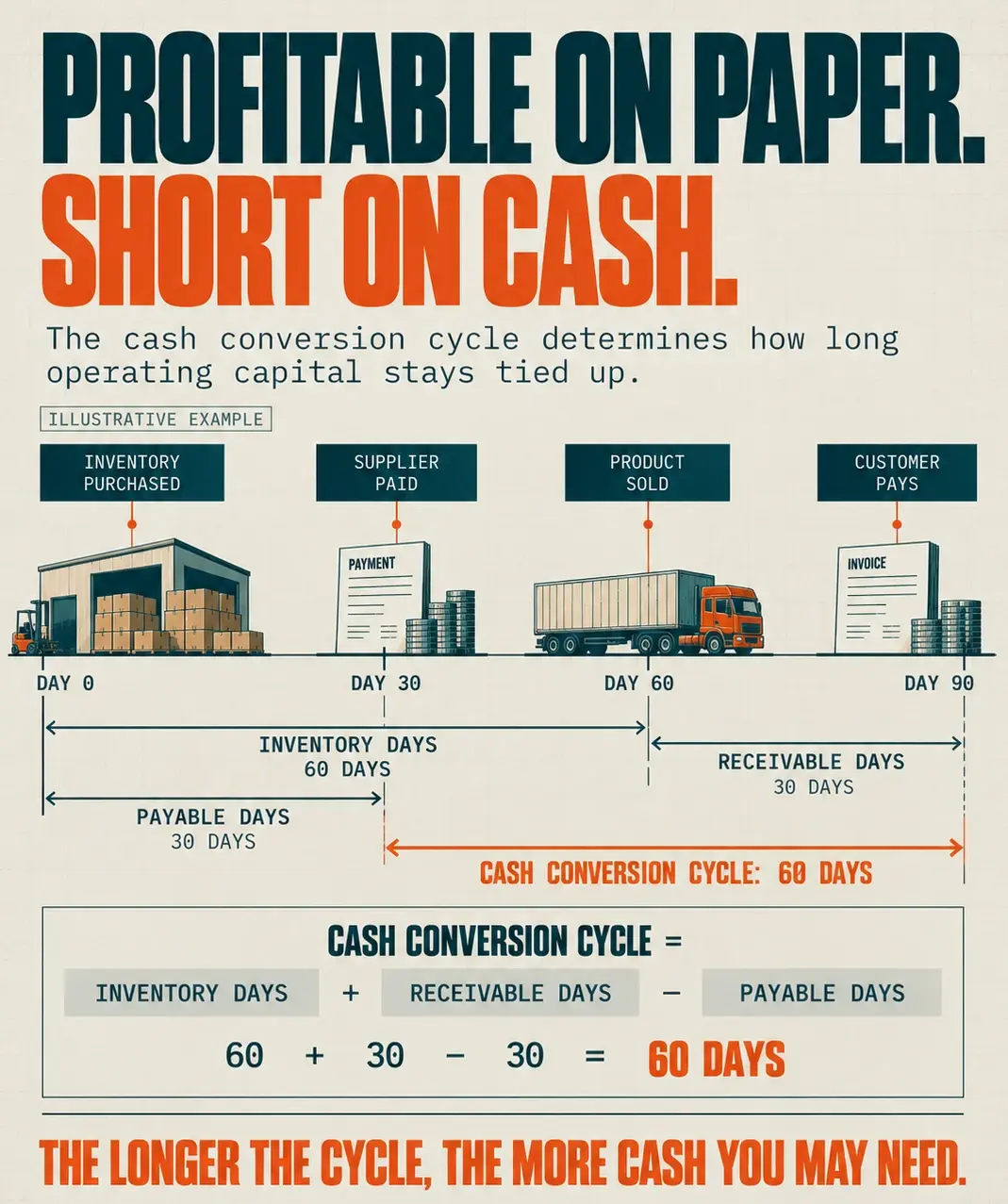
One of the biggest factors affecting how much cash a business needs to operate is timing. More specifically, its cash conversion cycle, which measures how long a business has to finance its operations before collecting payment from customers.
Cash Conversion Cycle = Inventory Days + Receivable Days − Payable Days
Consider a distributor that holds inventory for 60 days, takes another 30 days to collect payment, and pays its suppliers in 30 days.
That's a 60-day cash conversion cycle. The company is effectively financing two months of operations before the money comes back. If you buy that business without sufficient working capital, you're going to have a problem, regardless of what the income statement says.
This is why I spend so much time looking at the cash conversion cycle. I want to understand how money moves through the business, not simply how much money the business earns.
Here are a few questions I want buyers to ask:
- Does it collect deposits before performing the work?
- Does it have to buy inventory months before making a sale?
- Are customers paying in 30 days, 60 days, or 90 days?
- What are the supplier terms?
And don't assume the seller's arrangements will automatically become yours. A seller who's spent 25 years building relationships with suppliers may have favorable payment terms that aren't guaranteed to a new owner.
Permanent vs. Seasonal Working Capital: What's the Difference?
There are two types of working capital requirements buyers need to understand: permanent and seasonal (or temporary).
Permanent working capital is the baseline amount a business needs continuously to support its normal operations. A business might always need $300,000 tied up in inventory and receivables. That money isn't going to become available to the owner someday. The business needs it continuously.
Seasonal working capital is the additional amount needed during temporary periods of increased demand or expenses. Suppose that same business needs another $150,000 in inventory every holiday season. That's a temporary requirement, and a revolving line of credit may be a perfectly good way to finance it.
HEATHER'S FINANCING TIP
Don't use a line of credit to finance permanent working capital.
I don't like seeing buyers use a line of credit to fund permanent working capital because the line never really gets paid off. The business collects its receivables, but it immediately needs to purchase more inventory, pay more employees, and fund the next round of sales. So the balance stays outstanding.
You end up with what I call an evergreen line of credit. It's supposed to revolve, but it doesn't.
My preference is to finance permanent working capital with permanent capital, ideally as part of the acquisition. Save the revolving credit line for needs that actually revolve.
Is Working Capital Included in the Purchase Price?
I sometimes compare buying a business to buying a car.
You can negotiate a great price for the car, but you still need gas to drive it. And on your first day, your business is going to need a full tank of gas. The problem is that buyers don't always know whether the gas is included in the purchase price. With a car, the cost of a full tank is negligible compared to the purchase price. With a business, the working capital required to operate can be substantial.
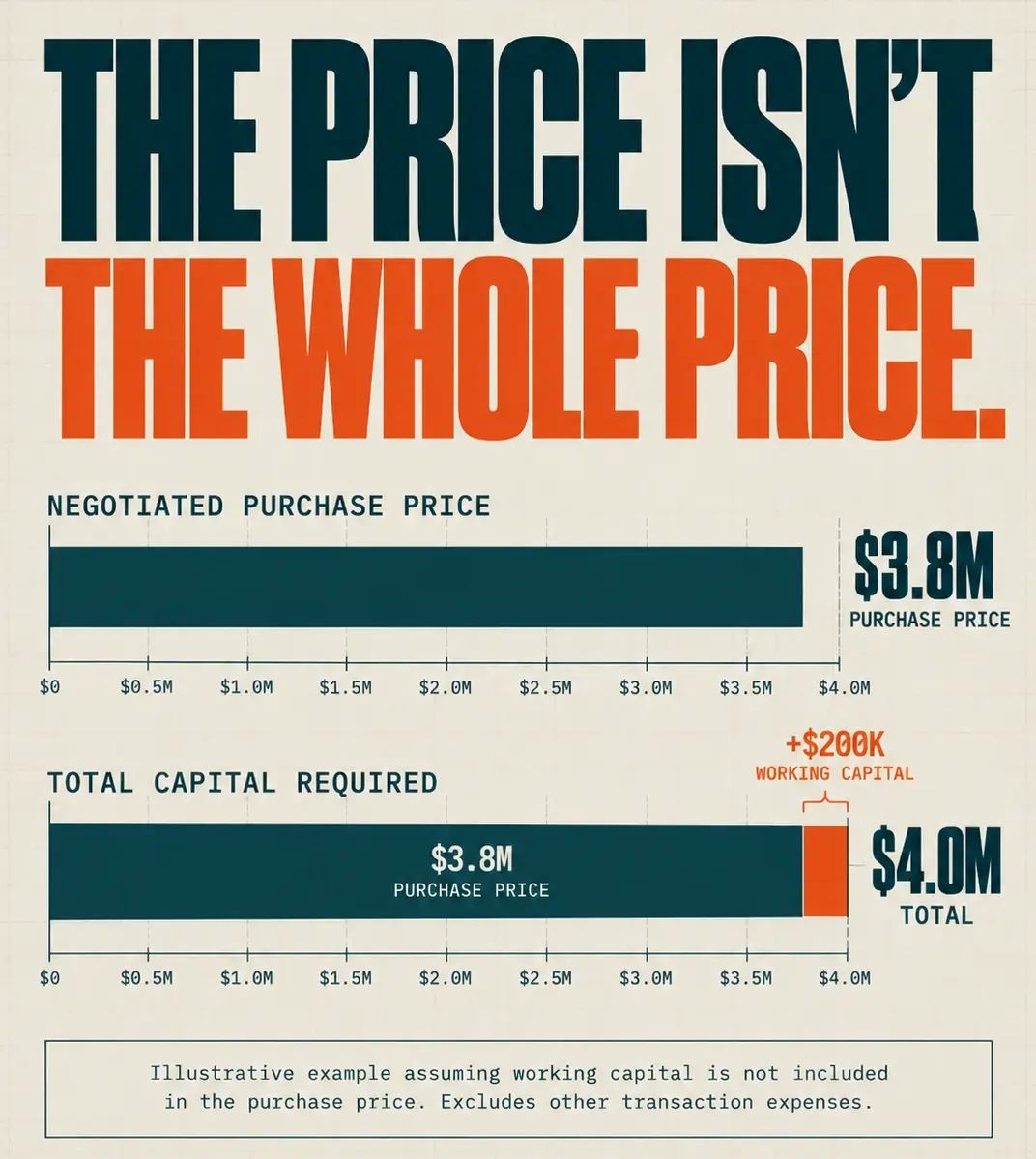
Let's say you're buying a business for $3.8 million. You negotiate a price you're happy with, and the seller agrees. But the business needs $200,000 in working capital to operate. If the seller is delivering that $200,000 as part of the purchase price, you're acquiring the business with the operating assets it needs.
If not, you need to find another $200,000. In this case, you're now looking at $4 million in total capital requirements before closing costs, even though you negotiated a $3.8 million purchase price.
And these amounts can get much larger. In one situation I've discussed, a seller had accumulated approximately $23 million in working capital. Not all of it was necessarily needed to operate the business, but it illustrates how consequential this negotiation can become.
The question isn't simply what the business is worth. It's what you're receiving for the price you're paying.
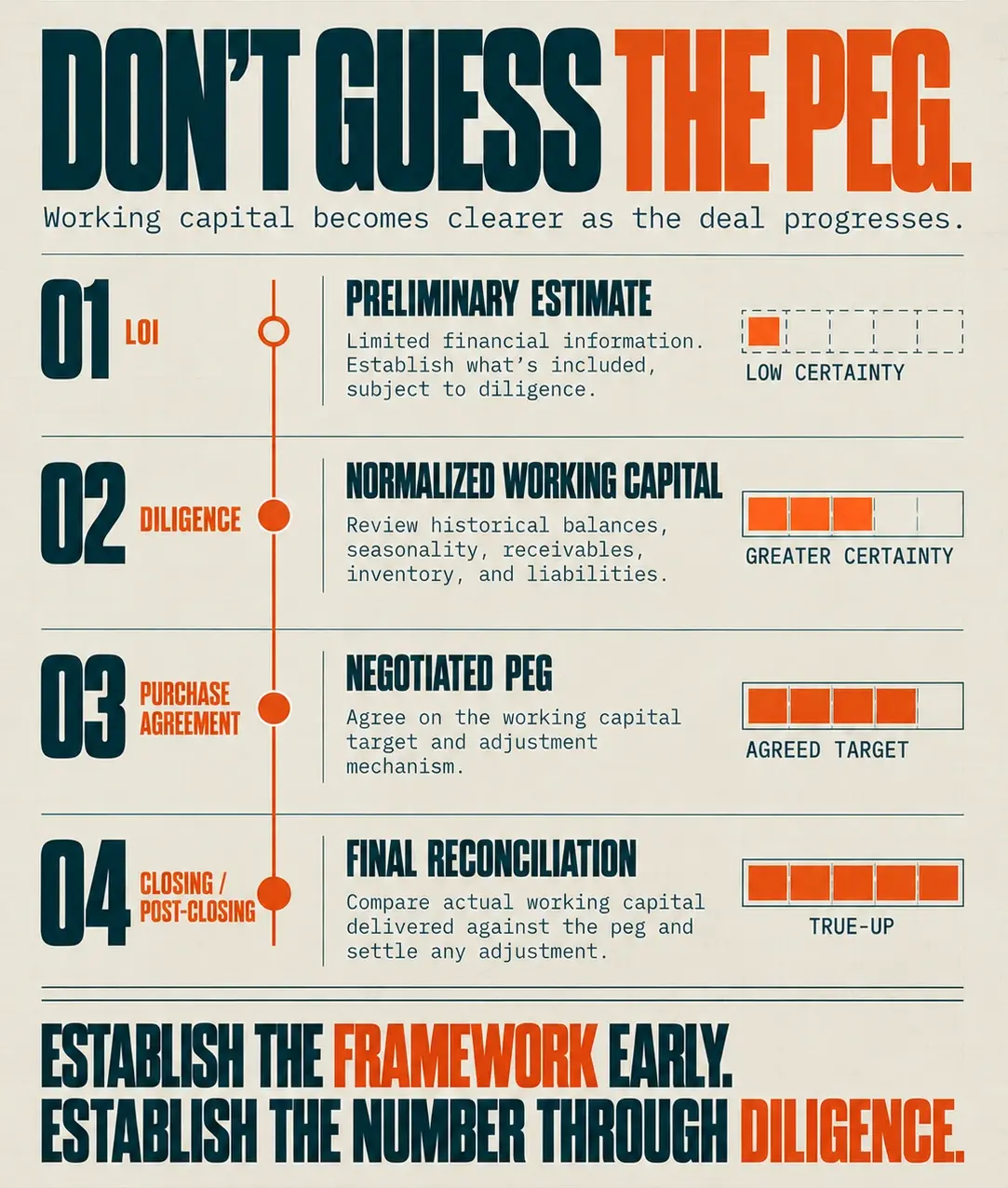
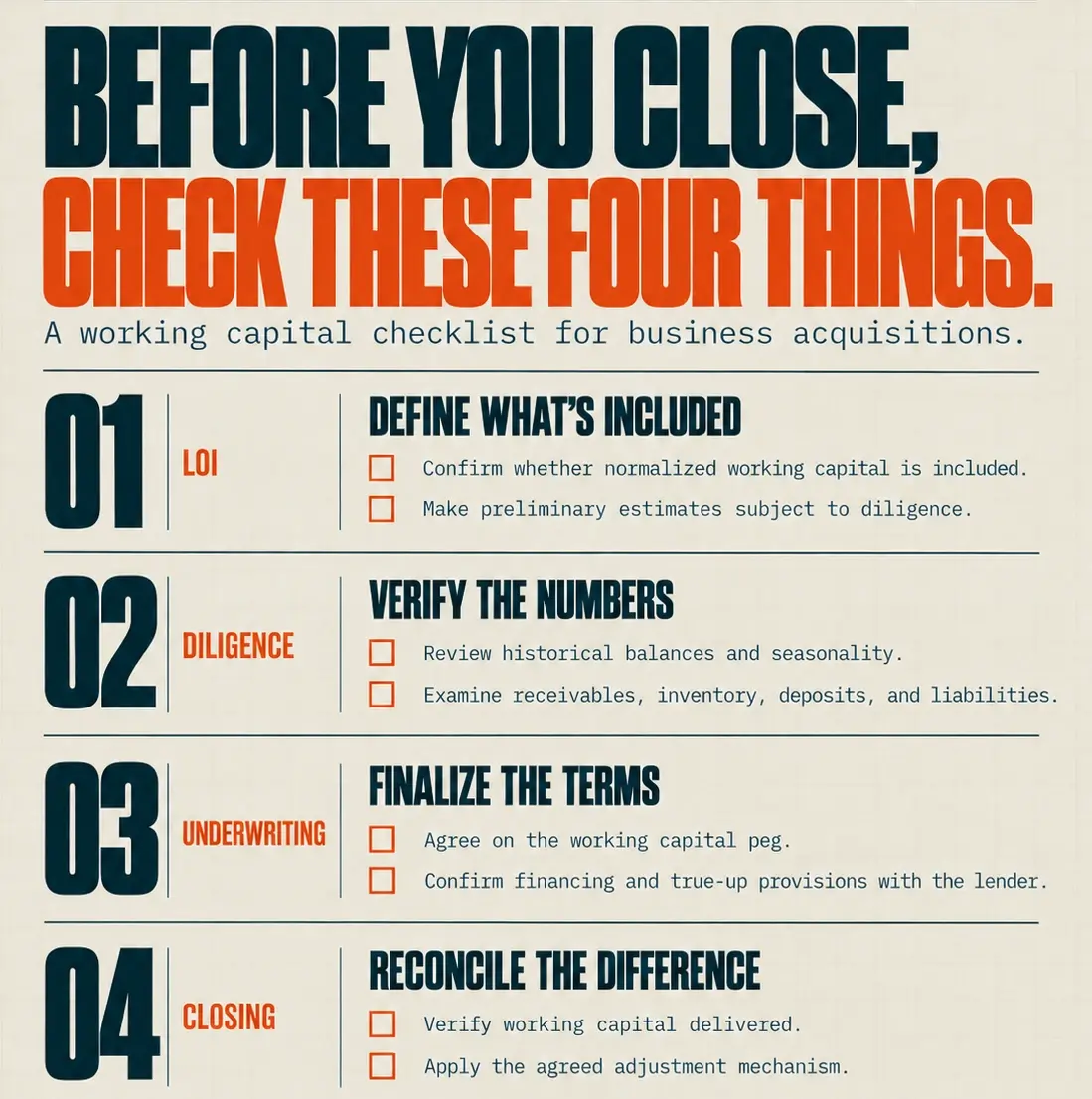
Because working capital can have such a significant impact on the economics of an acquisition, I want it addressed as early as the letter of intent. But that doesn't mean agreeing to a specific amount.
Don't Commit to a Working Capital Amount Before Diligence
One of my biggest frustrations with working capital negotiations is when buyers are pressured to commit to a specific amount before they have enough information to determine whether it's reasonable.
Business brokers and sellers understandably want certainty. They want to know the purchase price, how much cash they'll receive at closing, and what they're expected to leave in the business. So they'll ask the buyer to specify a working capital amount in the LOI.
But buyers usually haven't received enough information at that stage to determine what normalized working capital should be. They may have a few years of financial statements and a confidential information memorandum, but at that stage, they likely haven't examined monthly balances, seasonality, receivables, inventory requirements, and the actual cash conversion cycle.
I've talked with brokers who dislike leaving working capital undefined in an LOI because they worry the buyer will use it to renegotiate later. That's a legitimate concern, but committing to a number before diligence means the buyer may be agreeing to something they have no reasonable way to evaluate.
Agree on the Principle, Not a Number You Can't Yet Support
My recommendation is to find the middle ground. At the LOI stage, I want buyers to establish three things:
- What's included: Whether the purchase price includes normalized working capital.
- How it's calculated: Which operating assets and liabilities count toward the working capital amount.
- What's still subject to diligence: Any preliminary estimate should be explicitly conditional on further review.
For example, you might estimate that the business needs $250,000 in working capital, with the final amount to be determined through a working capital analysis.
That gives the seller some visibility without forcing the buyer to negotiate blind.
Should You Include Working Capital in the Acquisition or Finance It Separately?
My preference is generally to include the necessary permanent working capital in the acquisition purchase price rather than ask the bank to finance it separately.
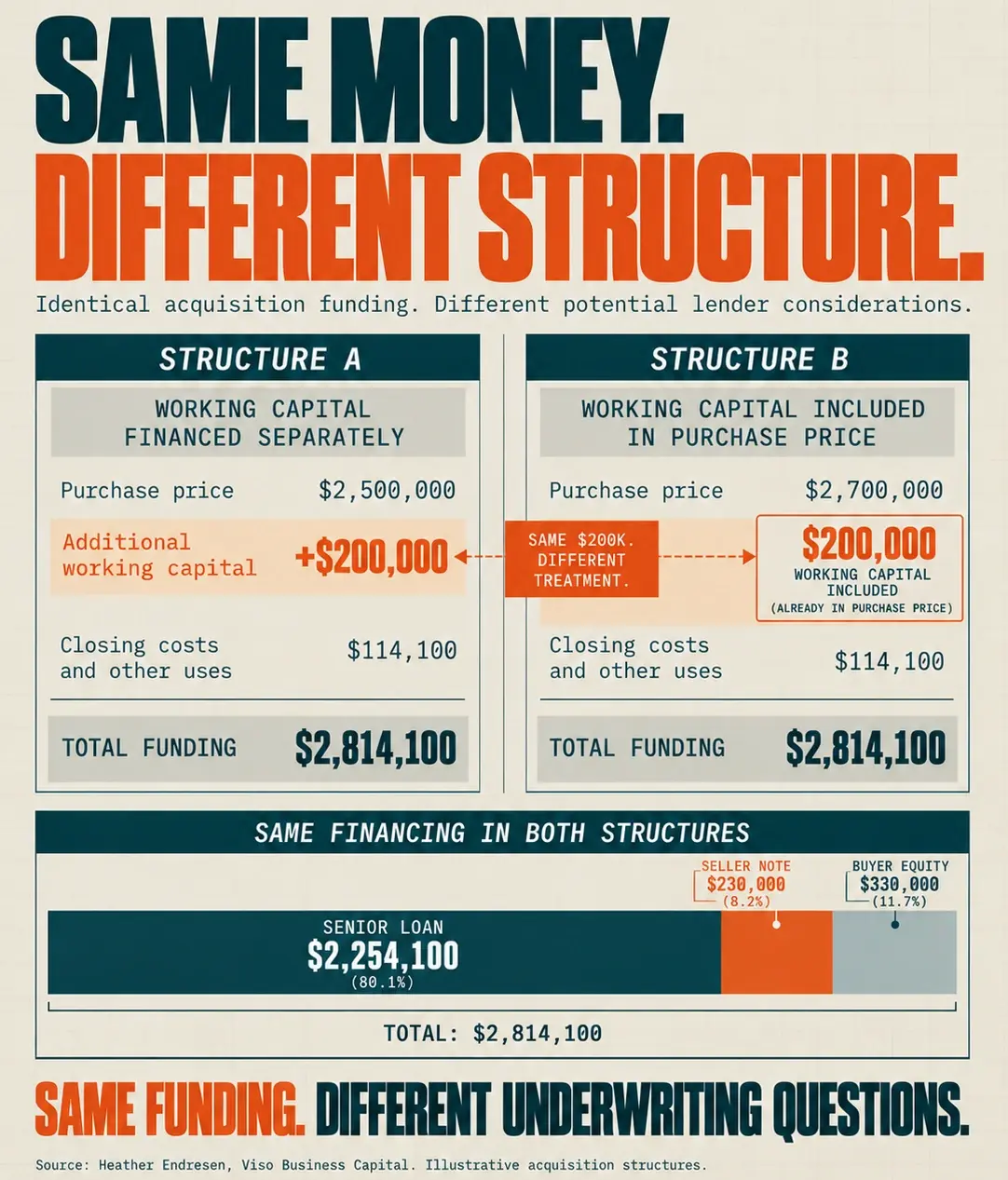
Consider two ways to structure an acquisition. Both require $2,814,100 in total funding, with the same senior loan, seller note, and buyer equity. The business needs $200,000 in working capital.
Structure A: The buyer purchases the business for $2.5 million and finances an additional $200,000 in working capital separately.
Structure B: The buyer purchases the business for $2.7 million, including the $200,000 in working capital the seller agrees to deliver.
The total funding requirement is identical, but the way the transaction is presented can affect how a bank evaluates it.
In my experience, some credit approvers get uncomfortable when they see a buyer contributing equity to acquire a business while simultaneously asking the bank to lend money for working capital. They look at that arrangement and think, Aren't we effectively giving the buyer their equity back?
I don't think that's the right way to evaluate the transaction. The business needs a certain amount of working capital to operate, regardless of how the sources and uses are presented. But I also know how bank underwriting works.
I've seen buyers get far into the acquisition process, spend money on diligence, and negotiate the transaction, only to have someone in the bank's credit department decide they're not comfortable financing as much working capital as originally contemplated. Now the buyer has to come up with more equity, renegotiate with the seller, or potentially lose the deal.
My recommendation is to negotiate the permanent working capital into the purchase price whenever possible. That way, the lender evaluates it as part of the acquisition rather than as a separate request that a credit approver might reduce late in underwriting. If the seller won't include the necessary working capital, the buyer still needs a reliable source of permanent funding, whether that's an approved term loan allocation or additional equity.
When the Seller Keeps the Deposits but You Inherit the Work
I think we can all agree that it's nice to get paid before we do the work.
That's part of what makes businesses that collect customer deposits so attractive to buyers. The customers are helping finance the company's operations. However, that same payment model can create a serious problem when the business changes hands.
The Buyer Inherits the Obligation, Not Necessarily the Cash
I was involved in a deal where the seller collected 50% deposits from customers months before performing the work. The seller had been recording those deposits as sales and spending the money.
The buyer would have inherited the obligation to complete the work, including paying for labor and materials, without receiving the money the customers had already paid. And because those deposits had been recorded as sales before the work was performed, the company's reported earnings were also misleading.
Once we understood what was happening, the deal no longer made sense. We walked away.
This is why I want buyers to examine outstanding customer deposits during diligence, not simply the cash balance on the seller's balance sheet.
How to Protect Yourself
Start by identifying deposits associated with work that won't be completed before closing. Determine what work remains, what it will cost, and how those obligations have been recorded in the financial statements.
Then negotiate how the transaction will account for them.
Depending on the deal, that might mean transferring the relevant deposit cash to the buyer, adjusting the purchase price, or including specific provisions for the deposits and liabilities being assumed.
The buyer needs to understand the economics of the outstanding work and make sure the obligations are accounted for without duplicating adjustments elsewhere in the transaction.
The same scrutiny should apply to the rest of the working capital:
- Accounts receivable: Are the outstanding invoices collectible?
- Inventory: Is it saleable, or is some of it obsolete?
- Work in progress: Is it actually billable?
- Accrued expenses and liabilities: What obligations will transfer to the buyer?
A balance sheet might show $300,000 in working capital, but that doesn't necessarily mean you're receiving $300,000 in useful operating assets.
Conversely, a business that collects customer payments upfront may operate with relatively little, or even negative, net working capital. That can be an attractive business model, provided you understand the obligations attached to those payments.
The goal isn't to negotiate the largest possible working capital balance. It's to make sure the assets and liabilities you're acquiring will allow you to operate the business as expected.
How Working Capital Pegs and True-Ups Actually Work
After diligence, you should have enough information to negotiate a working capital target and determine how differences at closing will be handled.
The Peg: What the Seller Agrees to Deliver
A working capital peg is the agreed amount of working capital the seller is expected to deliver at closing. It's generally established during diligence and documented in the purchase agreement.
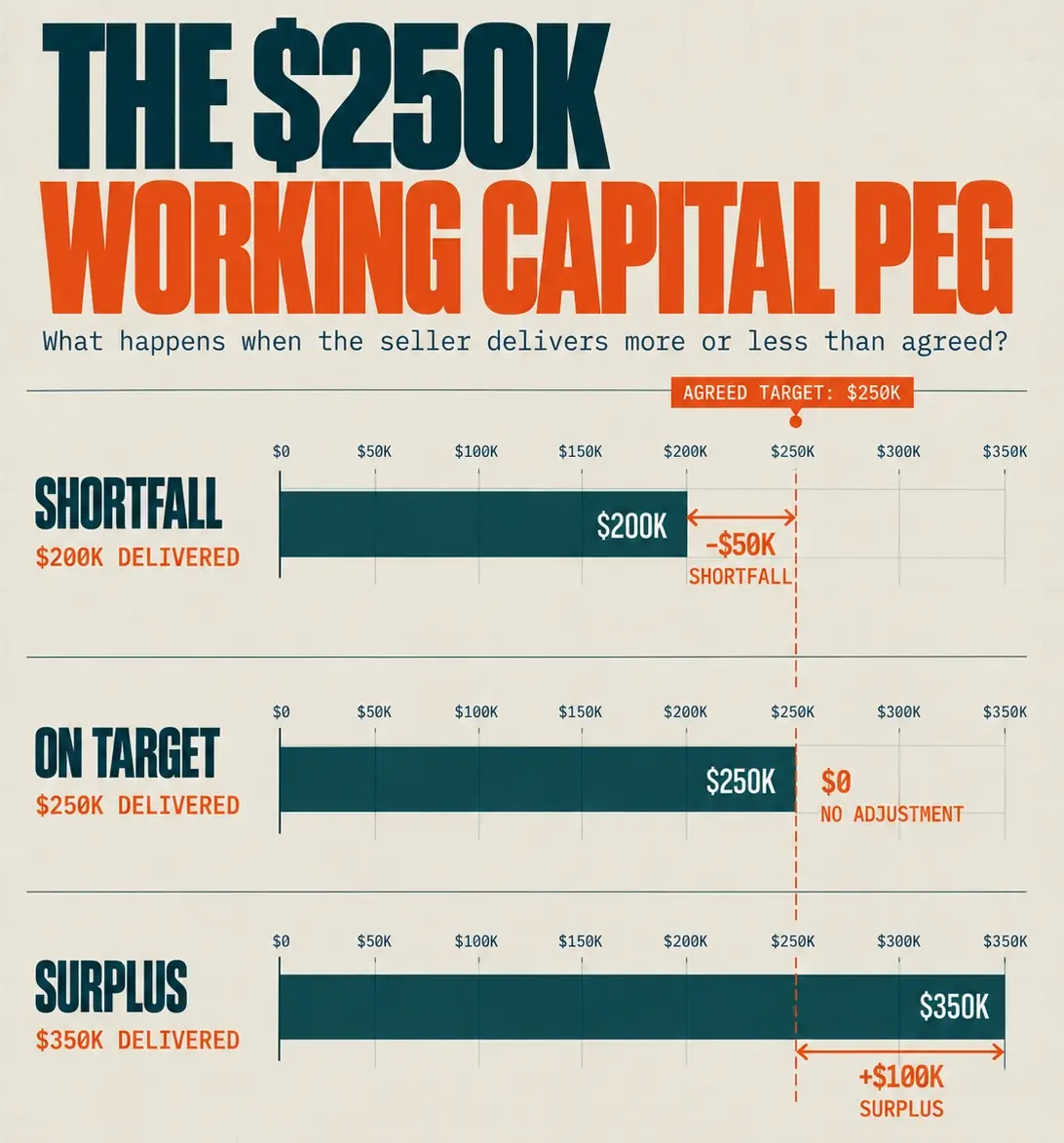
Let's say you've reviewed the historical working capital balances, accounted for seasonality, and determined that the business normally operates with $250,000 in working capital. You and the seller agree that $250,000 is the appropriate target. That's your peg.
But working capital changes constantly. Customers pay invoices, inventory gets purchased, and bills come due. You can't expect the balance to land on exactly $250,000 on closing day.
The True-Up: Reconciling What Was Actually Delivered
A working capital true-up reconciles the actual working capital delivered at closing against the agreed peg.
Suppose your peg is $250,000. If the seller delivers $200,000, there's a $50,000 shortfall. If the seller delivers $350,000, there's $100,000 more than the agreed amount.
The purchase agreement establishes how those differences will be calculated and settled. In a conventional transaction, a shortfall may result in an adjustment in the buyer's favor, while an excess may result in an adjustment in the seller's favor.
The peg is the target. The true-up is the reconciliation against that target.
SBA Loans Don't Automatically Prohibit Working Capital True-Ups
There's a misconception I encounter in SBA-financed acquisitions that working capital true-ups aren't allowed. I've seen lender counsel object to true-up language late in the closing process, and I've heard people say, “SBA loans don't allow working capital true-ups.” That blanket statement isn't correct.
A working capital true-up reconciles the operating assets and liabilities delivered at closing against what the parties agreed to. That's different from adjusting the purchase price based on how the business performs after the acquisition.
As I explained in a recent article on SBA working capital true-ups, properly structured working capital true-ups can be compatible with SBA-financed acquisitions. But the terms must comply with SBA requirements and the lender's approved financing structure.
That's why I want buyers to work through the true-up language with their lender and transaction attorney during underwriting. Make sure everyone agrees on what the adjustment is measuring, how it will be calculated, and how any payment will be handled. You don't want to spend months getting a deal approved only to discover that the working capital provisions are holding up your closing.
Buy a Business That's Ready to Operate
The most common problem I see isn't that buyers have never heard of working capital. It's that they negotiate the purchase price without establishing what working capital is included, how much is needed, or how the final amount will be determined.
Here's how I'd approach it.
You can negotiate a great purchase price, secure an attractive loan, and get all the way to the closing table. But if the business doesn't have what it needs to operate on day one, you've still got a problem.
Make sure you're buying the business with a full tank.
Ready to take the next step?Join Acquisition Lab
Get the frameworks, community, and expert guidance to find, evaluate, and close your first acquisition.
Apply Now
Join us at sea · January 2027Acquire It Summit 2027
Several days of focused programming, real deal breakdowns, and relationship-building with the ETA community aboard Virgin Voyages' Brilliant Lady. Sailing from Miami to Key West and Bimini.
Reserve Your Cabin